

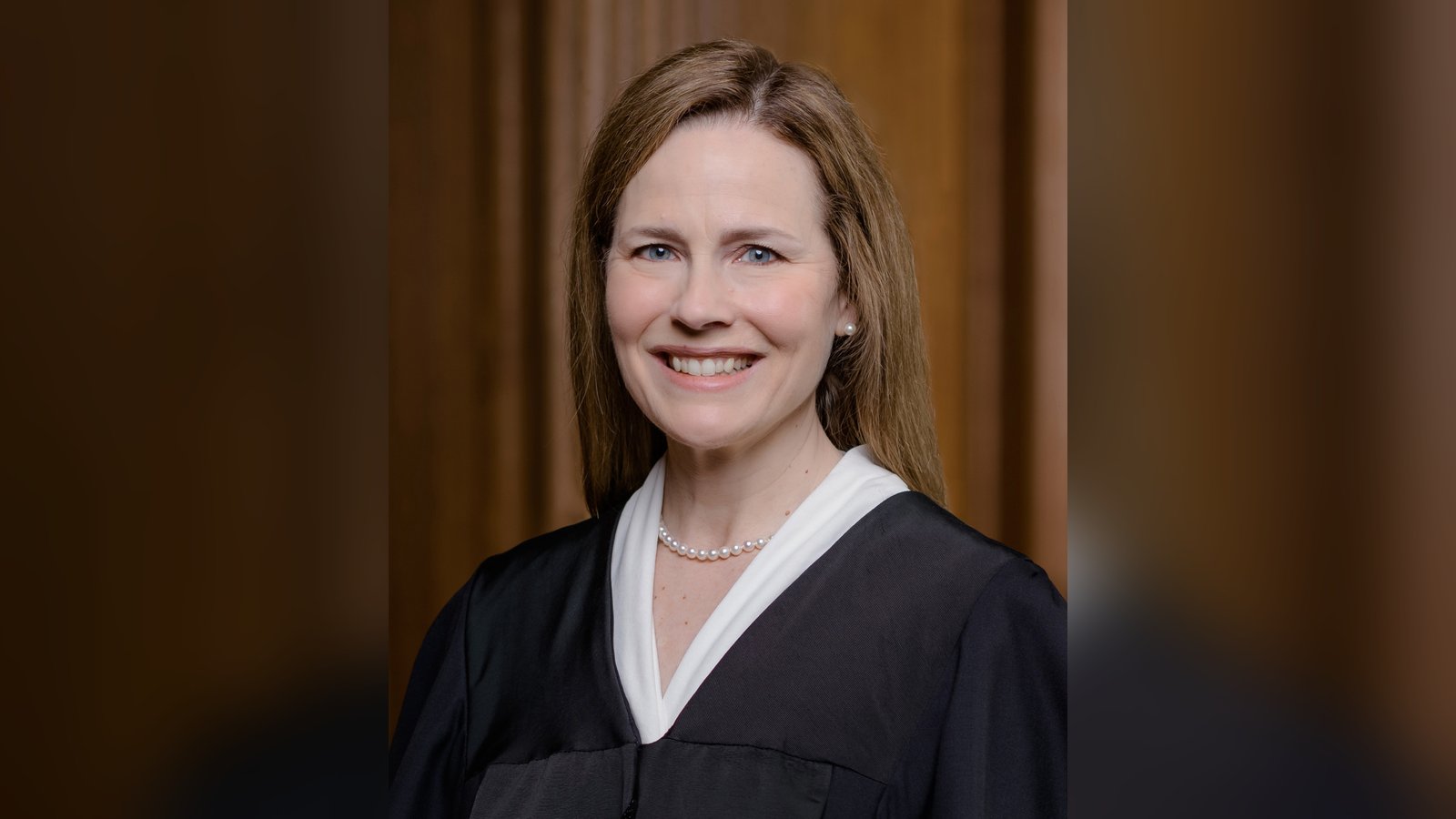
Last updated: 7 November 2026. This article covers the Supreme Court’s October Term 2025, the opinions released from November 2025 to the end of June 2026, plus orders through September 2026. Vote lineups are taken from the syllabus of each opinion on supremecourt.gov. Term statistics are from SCOTUSblog’s final Stat Pack, updated on 6 July 2026.
Short answer: Justice Amy Coney Barrett was in the majority in 92% of the 2025-26 term’s cases, behind Chief Justice Roberts and Justice Kavanaugh at 95%. Her votes still shaped the closest cases. She wrote the 5-4 mail ballot ruling in Watson v. RNC for Roberts and the three liberal justices, joined the birthright citizenship and tariff majorities, and dissented when the Court protected Fed Governor Lisa Cook.
Key takeaways
- Barrett wrote seven majority opinions in the term, including the 5-4 ruling in Watson v. Republican National Committee, where Roberts, Sotomayor, Kagan and Jackson joined her.
- She was in the majority 92% of the time, up from 89% the term before. Roberts and Kavanaugh were both at 95%, so she was not the justice most often on the winning side.
- She split from Roberts and Kavanaugh in both directions: she dissented in Trump v. Cook and Chatrie v. United States, where both of them were in the majority, and joined the majority in Hencely v. Fluor, where both dissented.
- In the term’s biggest cases against the Trump administration, she joined the majorities on tariffs and birthright citizenship, but would have let the President remove Lisa Cook while her case continues.
Who is Justice Amy Coney Barrett?
According to her official Supreme Court biography, Barrett was born in New Orleans on 28 January 1972. She graduated from Notre Dame Law School in 1997, clerked for Judge Laurence Silberman on the D.C. Circuit and for Justice Antonin Scalia, and taught at Notre Dame from 2002. President Trump appointed her to the Seventh Circuit in 2017 and then nominated her to the Supreme Court. She took her seat on 27 October 2020, which makes 2025-26 her sixth full term.
She sits in a 6-3 Court with five other justices appointed by Republican presidents. That is why her votes draw attention: when she, Roberts or Kavanaugh joins the three liberal justices, the result can flip. For background on how earlier decisions built the doctrines she applies, see our guide to landmark Supreme Court cases.
How often was Barrett in the majority in 2025-26?
SCOTUSblog’s term review by Jake Truscott and Adam Feldman gives these figures for the term:
| Measure | 2025-26 term | Previous term |
|---|---|---|
| Roberts in the majority | 95% | 95% |
| Kavanaugh in the majority | 95% | 92% |
| Barrett in the majority | 92% | 89% |
| Jackson in the majority (lowest) | 67% | 72% |
| Unanimous decisions | 44% | 42.4% |
| Decisions split 6-3 on ideological lines | 22.7% | 9% |
The final Stat Pack says the order was the same in non-unanimous and closely divided cases: Roberts and Kavanaugh first, Barrett third. So the numbers alone do not make Barrett the Court’s median justice. What makes her worth watching is where she landed when Roberts and Kavanaugh went the other way.
Which cases did Barrett decide or split on?
The table lists the term’s most closely watched divided cases with Barrett’s position. Each lineup is from the syllabus of the opinion on the Court’s 2025 term opinions page.
| Case (decided) | Issue | Vote | Barrett | Roberts and Kavanaugh |
|---|---|---|---|---|
| Bowe v. United States (9 Jan 2026) | Limits on federal prisoners’ successive habeas claims | 5-4 | Dissent (joined Part I of Gorsuch’s dissent) | Both in majority |
| Learning Resources v. Trump (20 Feb 2026) | Whether IEEPA lets the President impose tariffs | 6-3 | Majority, plus a concurrence | Roberts wrote it; Kavanaugh dissented |
| Hencely v. Fluor Corp. (22 Apr 2026) | Preemption of tort claims against a military contractor | 6-3 | Majority (Thomas) | Both dissented, with Alito |
| Louisiana v. Callais (29 Apr 2026) | Race and the Voting Rights Act in redistricting | 6-3 | Majority (Alito) | Both in majority |
| Trump v. Slaughter (29 Jun 2026) | President’s power to remove an FTC commissioner | 6-3 | Majority (Roberts) | Both in majority |
| Trump v. Cook (29 Jun 2026) | Stay of order keeping Fed Governor Lisa Cook in office | 5-4 | Dissent, own opinion | Both in majority |
| Chatrie v. United States (29 Jun 2026) | Whether getting phone location data is a Fourth Amendment search | 6-3 | Dissent, own opinion | Both in majority |
| Watson v. RNC (29 Jun 2026) | Counting mail ballots that arrive after election day | 5-4 | Wrote majority | Roberts joined; Kavanaugh dissented |
| Trump v. Barbara (30 Jun 2026) | Birthright citizenship executive order | 6-3 judgment | Joined Roberts’s majority opinion | Kavanaugh concurred in the judgment only |
| West Virginia v. B.P.J. (30 Jun 2026) | Limiting girls’ school sports teams to biological females | 6-3 | Majority (Kavanaugh) | Both in majority |
Two patterns stand out. First, in the ideological 6-3 cases (Callais, Slaughter, B.P.J.) Barrett voted with the other five conservatives. Second, in the cases that did not split on familiar lines, she did not simply follow the Chief Justice. She left him in Bowe, Cook and Chatrie, and joined Thomas against him in Hencely.
What did Barrett decide in Watson v. RNC?
Watson was the term’s clearest case of Barrett deciding the outcome. Mississippi counts absentee ballots postmarked by election day if they arrive within five days. The Republican National Committee argued that federal election day statutes require ballots to be received by election day. The Fifth Circuit agreed.
Barrett’s opinion for the Court reversed. Nothing in the federal statutes, she wrote, requires receipt by election day. Roberts, Sotomayor, Kagan and Jackson joined her. Alito dissented with Thomas and Gorsuch, and Kavanaugh joined most of that dissent. With the vote at 5-4, a switch by Barrett would have changed the result in every state that counts late-arriving mail ballots.
Where did Barrett side against the Trump administration?
Two of the term’s largest cases went against the administration with Barrett in the majority.
- Tariffs. In Learning Resources v. Trump, the Court held that the International Emergency Economic Powers Act does not authorise the President to impose tariffs. Barrett joined every part of the Chief Justice’s opinion, including the parts that relied on the major questions doctrine, which only she and Gorsuch joined, and she wrote a concurrence. Kavanaugh dissented with Thomas and Alito. Our explainer on the major questions doctrine sets out how her view of it differs from Gorsuch’s.
- Birthright citizenship. In Trump v. Barbara, Barrett joined Roberts’s opinion holding that children born in the United States to parents who are unlawfully or temporarily present are citizens at birth. Thomas, Alito and Gorsuch dissented. Kavanaugh agreed with the result on statutory grounds only. Our guide to Trump v. Barbara covers each opinion.
Where did Barrett side with the administration or the government?
She also cast votes the other way, and these are the ones that separate her from Roberts and Kavanaugh.
- Trump v. Cook. The Court refused, 5-4, to stay an order keeping Lisa Cook on the Federal Reserve Board while her case continues. It found the government unlikely to succeed because the President had not given her the notice and chance to respond that the statute requires. Kavanaugh joined the Chief Justice. Barrett wrote a dissent; the majority describes her as saying she would have granted the government’s application. Thomas and Alito, with Gorsuch, also dissented.
- Trump v. Slaughter. Barrett joined the 6-3 majority allowing the President to remove a commissioner of the Federal Trade Commission. See our analysis of Trump v. Slaughter and Humphrey’s Executor.
- Chatrie v. United States. The Court held, 6-3, that police conduct a Fourth Amendment search when they obtain a person’s phone location data from a company. Barrett dissented in a short opinion of her own and joined parts of Alito’s dissent. Roberts and Kavanaugh joined Kagan’s majority. Our guide asks whether police can track your phone without a warrant after this ruling.
Is Amy Coney Barrett really a swing vote?
It depends on what you mean. If a swing justice is the one most often in the majority, the label belonged to Roberts and Kavanaugh in 2025-26, each at 95%. If it means a justice whose vote decided close cases and who did not vote as a bloc, Barrett fits better than her 92% suggests.
The evidence for that reading is the pattern above. Barrett was the decisive fifth vote in Watson and wrote it. In Cook and Chatrie she was in a conservative minority that Roberts and Kavanaugh left. In Hencely she joined Thomas and the liberal justices against Roberts, Alito and Kavanaugh. Her votes in the tariff and birthright citizenship cases matched Roberts but not Kavanaugh.
Our reading, which is analysis rather than data: Barrett tends to decide on her own reading of the text and the procedure in each case, rather than on who wins. That makes her harder to predict than her overall majority rate implies. Not every 5-4 case shows her position in the public summary data, so we have only listed cases where we read the lineup ourselves.
Which opinions did Barrett write in 2025-26?
The Stat Pack credits her with seven majority opinions:
- Berk v. Choy (9-0)
- Montgomery v. Caribe Transport II (9-0)
- Fernandez v. United States (8-1)
- Rutherford v. United States (6-3)
- FS Credit Opportunities v. Saba Capital (6-3)
- Cisco Systems v. Doe (6-3)
- Watson v. Republican National Committee (5-4)
She also wrote separately in Learning Resources (concurring), Wolford v. Lopez (concurring), Trump v. Cook (dissenting) and Chatrie (dissenting). The Stat Pack lists her Chatrie dissent, at about 60 words, as the term’s shortest individual opinion.
What should lawyers and students take from her term?
- Brief to the text. Watson and the tariff case turned on what the statute says. Arguments built on policy alone did not carry her.
- Do not count her as a sure vote. Both sides lost her in at least one major case this term.
- Read her separate writings. Her concurrences and short dissents often signal how she will approach the next case in the same area.
- Watch emergency applications. Cook came to the Court as an application for a stay, and her vote there differed from her merits votes against the administration.
Frequently asked questions
How often was Amy Coney Barrett in the majority in the 2025-26 term?
SCOTUSblog reports that Barrett was in the majority 92% of the time in the 2025-26 term, up from 89% the term before. Chief Justice Roberts and Justice Kavanaugh were both in the majority 95% of the time, and Justice Jackson was lowest at 67%.
Did Justice Barrett vote against the Trump administration?
Yes, in some major cases. She joined the majorities that held the IEEPA tariffs unlawful and that upheld birthright citizenship. She sided with the administration in Trump v. Slaughter and dissented in Trump v. Cook, where she would have let the President remove Fed Governor Lisa Cook while the case continues.
What was Watson v. Republican National Committee about?
It asked whether federal election day statutes stop Mississippi counting mail ballots postmarked by election day that arrive up to five days later. Barrett wrote for a 5-4 majority that they do not. Roberts, Sotomayor, Kagan and Jackson joined her, and four conservative justices dissented.
How does Barrett compare with Roberts and Kavanaugh?
All three sit near the centre of the Court, but they split often this term. Barrett dissented in Cook, Chatrie and Bowe when Roberts and Kavanaugh were in the majority, and joined the majority in Hencely when both dissented. Kavanaugh dissented in the tariff case and in Watson, while Barrett and Roberts were in the majority.
How many majority opinions did Barrett write in 2025-26?
Seven, according to SCOTUSblog’s final Stat Pack: Berk v. Choy, Montgomery v. Caribe Transport II, Fernandez v. United States, Rutherford v. United States, FS Credit Opportunities v. Saba Capital, Cisco Systems v. Doe and Watson v. Republican National Committee.
When did Amy Coney Barrett join the Supreme Court?
She took her seat on 27 October 2020 after President Trump nominated her. Before that she sat on the Seventh Circuit from 2017 and taught at Notre Dame Law School from 2002. The 2025-26 term was her sixth full term on the Court.
This article is general legal information as of 7 November 2026. It is not legal advice. Vote counts are taken from the Court’s published opinions and may be revised in the bound United States Reports.
Featured image: Photo: United States Supreme Court via Wikimedia Commons, public domain (US government work), adapted
Where the legal industry reads first.
Enjoyed this article? Get the biggest legal industry updates, deals, appointments, insights and expert interviews in your inbox, free.
No spam. Unsubscribe anytime.From Legal Desire
Is your firm the one being cited, or the one being skipped?
We ran the test. On several everyday legal questions, software companies are answering and law firms are not. We help firms fix that, and we build the technology behind the practice.
Lawyers and firms: get featured on Legal Desire
Share your deals, lateral moves, firm news and insights with 1M+ monthly readers: founders, law firm partners, general counsel and practising lawyers across the US, UK, EU and GCC.
Get featuredSubmit a press release