

Last updated: 26 November 2026. Sources: the text of the Fourteenth Amendment, the National Archives, the Supreme Court’s opinion in Trump v. Barbara (30 June 2026), Executive Order 14418, and Supreme Court decisions on citizenship, due process, equal protection and Section 3.
Short answer: The 14th Amendment, ratified in 1868 after the Civil War, makes everyone born or naturalised in the United States and subject to its jurisdiction a citizen, and bars states from denying any person due process of law or the equal protection of the laws. On 30 June 2026, in Trump v. Barbara, the Supreme Court held that it protects the citizenship of children born to parents here unlawfully or temporarily.
Key takeaways
- The 14th Amendment was passed by Congress on 13 June 1866 and ratified on 9 July 1868. It overturned Dred Scott v. Sandford, which had held that descendants of enslaved people could not be citizens.
- Section 1 contains the four clauses that matter most in court today: Citizenship, Privileges or Immunities, Due Process and Equal Protection.
- In Trump v. Barbara, decided on 30 June 2026 after argument on 1 April, five justices held that Executive Order 14160 violated the Citizenship Clause. Justice Kavanaugh agreed it was unlawful, but only under a federal statute, making the judgment 6 to 3.
- The President signed a narrower order, Executive Order 14418, on 6 August 2026. A Maryland federal judge temporarily blocked it on 2 September 2026, and that litigation is continuing.
What is the 14th Amendment?
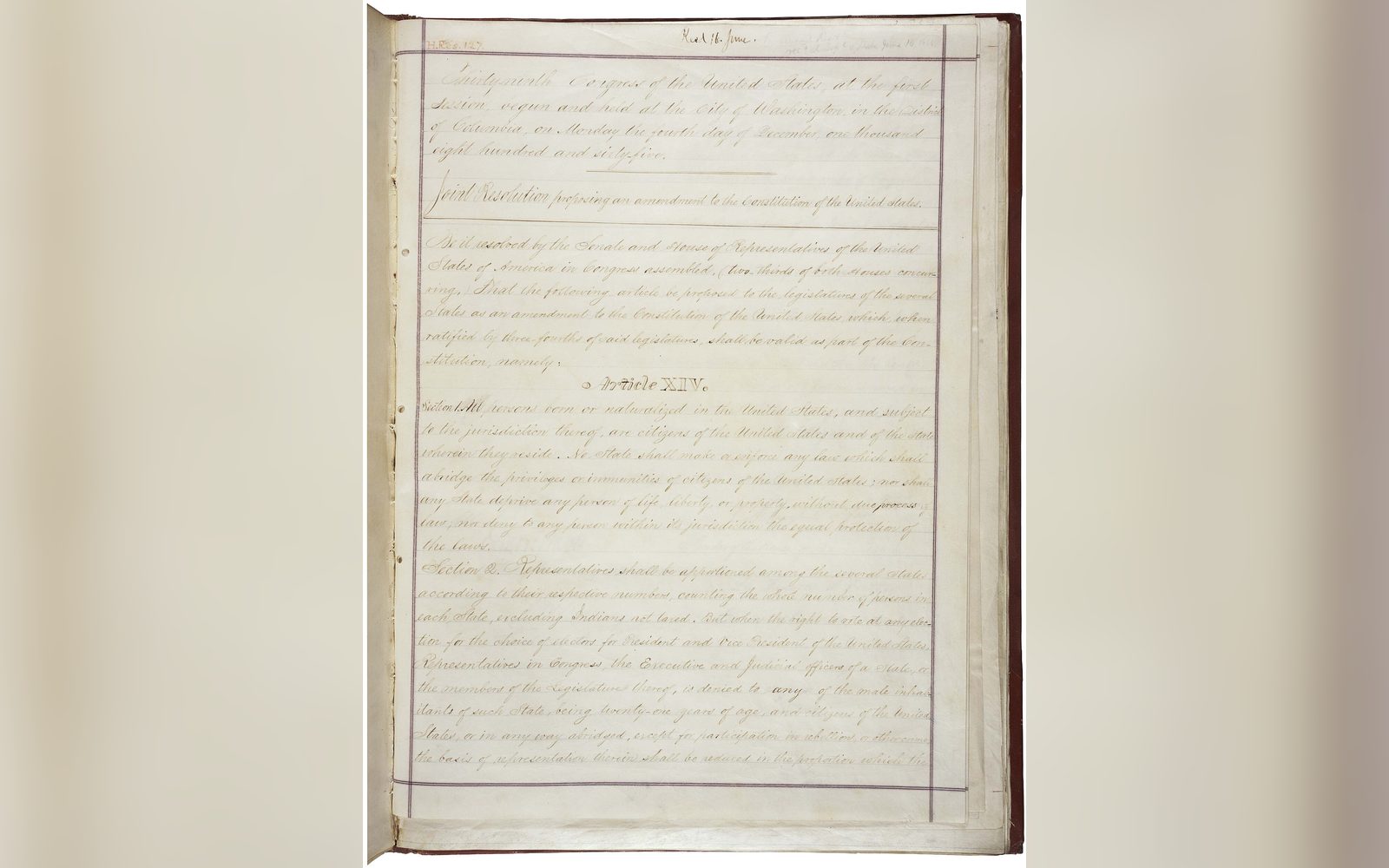
The Fourteenth Amendment is one of three Reconstruction amendments adopted after the Civil War, alongside the 13th (abolishing slavery) and the 15th (barring race discrimination in voting). According to the National Archives, Congress passed it on 13 June 1866, it was ratified on 9 July 1868, and the Secretary of State certified its ratification on 28 July 1868.
Its first purpose was to secure citizenship and equal civil rights for formerly enslaved people. Its wider effect was to change the balance between the states and the federal government. The original Bill of Rights restrained only the federal government. The 14th Amendment placed limits on the states themselves and gave federal courts and Congress the power to enforce them. That is why so many of the cases in our list of landmark Supreme Court cases turn on it.
What does each section of the 14th Amendment say?
The amendment has five sections. You can read the full text of the 14th Amendment on Cornell’s Legal Information Institute.
| Section | What it does | Leading or recent case |
|---|---|---|
| Section 1 | Defines citizenship and bars states from abridging the privileges or immunities of citizens, depriving any person of life, liberty or property without due process, or denying any person equal protection of the laws | Trump v. Barbara (2026), Brown v. Board of Education (1954), Obergefell v. Hodges (2015) |
| Section 2 | Apportions House seats by total population and reduces a state’s representation if it denies the vote to eligible male citizens | The reduction penalty has never been applied |
| Section 3 | Disqualifies from office anyone who swore an oath to support the Constitution and then engaged in insurrection or rebellion, unless Congress removes the bar by a two-thirds vote | Trump v. Anderson (2024) |
| Section 4 | Confirms the validity of the US public debt and voids Confederate debts and claims for freed slaves | Raised in debt ceiling debates, rarely litigated |
| Section 5 | Gives Congress power to enforce the amendment by appropriate legislation | City of Boerne v. Flores (1997) |
What does the Citizenship Clause mean?
The first sentence of Section 1 reads: “All persons born or naturalized in the United States, and subject to the jurisdiction thereof, are citizens of the United States and of the State wherein they reside.” This is the constitutional basis of birthright citizenship, or jus soli (right of the soil).
The key case for 128 years was United States v. Wong Kim Ark (28 March 1898). Wong Kim Ark was born in San Francisco to Chinese parents who could not themselves become citizens. The Court held that he was a citizen at birth, because the amendment adopted the common law rule that almost everyone born on the nation’s soil is a citizen. The narrow exceptions were children of foreign diplomats, children of enemy forces in hostile occupation and, at the time, members of sovereign Native American tribes.
The phrase “subject to the jurisdiction thereof” is what those exceptions hang on, and it is the phrase the government relied on in 2025 to argue that children of unlawfully or temporarily present parents fall outside the clause.
What did the Supreme Court decide on birthright citizenship in 2026?
On 20 January 2025, President Trump signed Executive Order 14160. It told federal agencies not to recognise as citizens children born in the US to a mother unlawfully or temporarily present, unless the father was a citizen or lawful permanent resident. After the Court limited universal injunctions in Trump v. CASA in June 2025, challengers in New Hampshire sued as a class. The district court provisionally certified a nationwide class of affected children and blocked the order, and the Supreme Court took the case before the First Circuit ruled.
The Court heard argument on 1 April 2026 and decided Trump v. Barbara on 30 June 2026. The syllabus states the holding in one sentence: children born in the United States to parents unlawfully or temporarily present “are ‘subject to the jurisdiction’ of the United States and are citizens at birth under the Fourteenth Amendment’s Citizenship Clause.”
- Majority: Chief Justice Roberts, joined by Justices Sotomayor, Kagan, Barrett and Jackson. The opinion traces the rule from English common law through the rejection of Dred Scott and reads Wong Kim Ark as rejecting any requirement that parents be domiciled in the US. It ends: “Citizenship, then and now, was the right to have rights.”
- Concurrence: Justice Jackson wrote separately, joined in part by Justice Sotomayor.
- Concurring in the judgment: Justice Kavanaugh said the order does not violate the Constitution but does breach 8 U.S.C. 1401(a), the statute that confers citizenship using the same words. Congress “has not yet” changed that statute, he wrote.
- Dissents: Justice Thomas, joined by Justice Gorsuch, with separate dissents by Justices Alito and Gorsuch.
So the judgment against the order was 6 to 3, but the constitutional holding rested on five votes. Our case note on Trump v. Barbara covers the opinions in more depth, and our profile of Justice Amy Coney Barrett looks at her votes across the 2025-26 term.
The dispute has continued. On 6 August 2026 the President signed Executive Order 14418, which targets narrower categories where neither parent is a citizen, including children of foreign government officials, members of designated terrorist organisations, paid birth arrangements and births in some territories. On 2 September 2026, Judge Deborah Boardman in Maryland temporarily blocked its enforcement against the children covered by her ruling, writing that the order “is almost certainly unconstitutional” as applied to them.
What is due process under the 14th Amendment?
The Due Process Clause says no state shall “deprive any person of life, liberty, or property, without due process of law”. The Fifth Amendment says the same of the federal government. Courts read the clause in two ways.
Procedural due process means fair procedures before the state takes something away: notice, a chance to be heard and a neutral decision-maker. In Mathews v. Eldridge (1976), the Court set the test still used today, weighing the private interest at stake, the risk of error and the value of extra safeguards, and the government’s interest.
Substantive due process protects certain rights from state interference however fair the procedure. It is the route by which most of the Bill of Rights now binds the states, known as incorporation. McDonald v. Chicago (2010), for example, applied the Second Amendment to states and cities. It has also been used to protect unenumerated rights, such as the right to marry in Obergefell v. Hodges (2015). In Dobbs v. Jackson Women’s Health Organization (2022), the Court held there is no constitutional right to abortion and said unenumerated rights must be deeply rooted in the nation’s history and tradition.
What does the Equal Protection Clause require?
The clause bars a state from denying “to any person within its jurisdiction the equal protection of the laws”. Because it says “any person”, it protects non-citizens too; in Plyler v. Doe (1982), the Court held that Texas could not deny free public schooling to undocumented children.
Courts test laws that treat groups differently at three levels:
- Strict scrutiny for classifications by race or national origin: the law must be narrowly tailored to a compelling interest. Brown v. Board of Education (1954) ended school segregation, Loving v. Virginia (1967) struck down bans on interracial marriage, and Students for Fair Admissions v. Harvard (2023) ended race-conscious admissions at Harvard and the University of North Carolina.
- Intermediate scrutiny for sex-based classifications: the law must substantially serve an important government objective.
- Rational basis review for most other laws: the law needs only a rational link to a legitimate aim. In United States v. Skrmetti (18 June 2025), the Court applied this standard to uphold Tennessee’s ban on certain gender-transition treatments for minors.
Equal protection also shapes criminal procedure. It forbids striking jurors because of their race, as our guide to voir dire explains, and it underpins claims of selective prosecution.
What do Sections 3 and 5 do?
Section 3, the insurrection clause, was written to keep former Confederate officials out of office. It returned to the news when Colorado’s Supreme Court removed Donald Trump from its 2024 primary ballot. In Trump v. Anderson (4 March 2024), the US Supreme Court reversed, holding that states have no power to enforce Section 3 against federal officeholders and candidates; that responsibility rests with Congress.
Section 5 lets Congress enforce the amendment by “appropriate legislation”. Civil rights statutes rely on it, but in City of Boerne v. Flores (1997) the Court held that such laws must show “congruence and proportionality” between the harm and the remedy, which limits how far Congress can go beyond the Court’s own reading of the amendment.
This article is general information about the US Constitution as of 26 November 2026, not legal advice. Litigation over Executive Order 14418 is ongoing, so check for later rulings.
Frequently asked questions
What does the 14th Amendment say in simple terms?
Anyone born or naturalised in the US and subject to its laws is a citizen, and no state may deny any person fair legal process or equal treatment under the law. It also deals with representation, insurrection, public debt and enforcement by Congress.
When was the 14th Amendment ratified?
On 9 July 1868. Congress had passed it on 13 June 1866, and the Secretary of State certified ratification on 28 July 1868.
Does the 14th Amendment guarantee birthright citizenship?
Yes. In Trump v. Barbara (30 June 2026), the Supreme Court held that children born in the US to parents unlawfully or temporarily present are citizens at birth under the Citizenship Clause.
What was the vote in Trump v. Barbara?
Six justices agreed the executive order was unlawful. Five held it unconstitutional, while Justice Kavanaugh relied on a federal statute only. Justices Thomas, Alito and Gorsuch dissented.
What is the difference between due process and equal protection?
Due process concerns how the state treats a person, meaning fair procedures and certain protected rights. Equal protection concerns how the state treats groups compared with each other.
Does the 14th Amendment apply to non-citizens?
Yes. The Due Process and Equal Protection Clauses protect “any person”, not only citizens, as the Supreme Court confirmed in Plyler v. Doe (1982).
Where the legal industry reads first.
Enjoyed this article? Get the biggest legal industry updates, deals, appointments, insights and expert interviews in your inbox, free.
No spam. Unsubscribe anytime.From Legal Desire
Is your firm the one being cited, or the one being skipped?
We ran the test. On several everyday legal questions, software companies are answering and law firms are not. We help firms fix that, and we build the technology behind the practice.
Lawyers and firms: get featured on Legal Desire
Share your deals, lateral moves, firm news and insights with 1M+ monthly readers: founders, law firm partners, general counsel and practising lawyers across the US, UK, EU and GCC.
Get featuredSubmit a press release