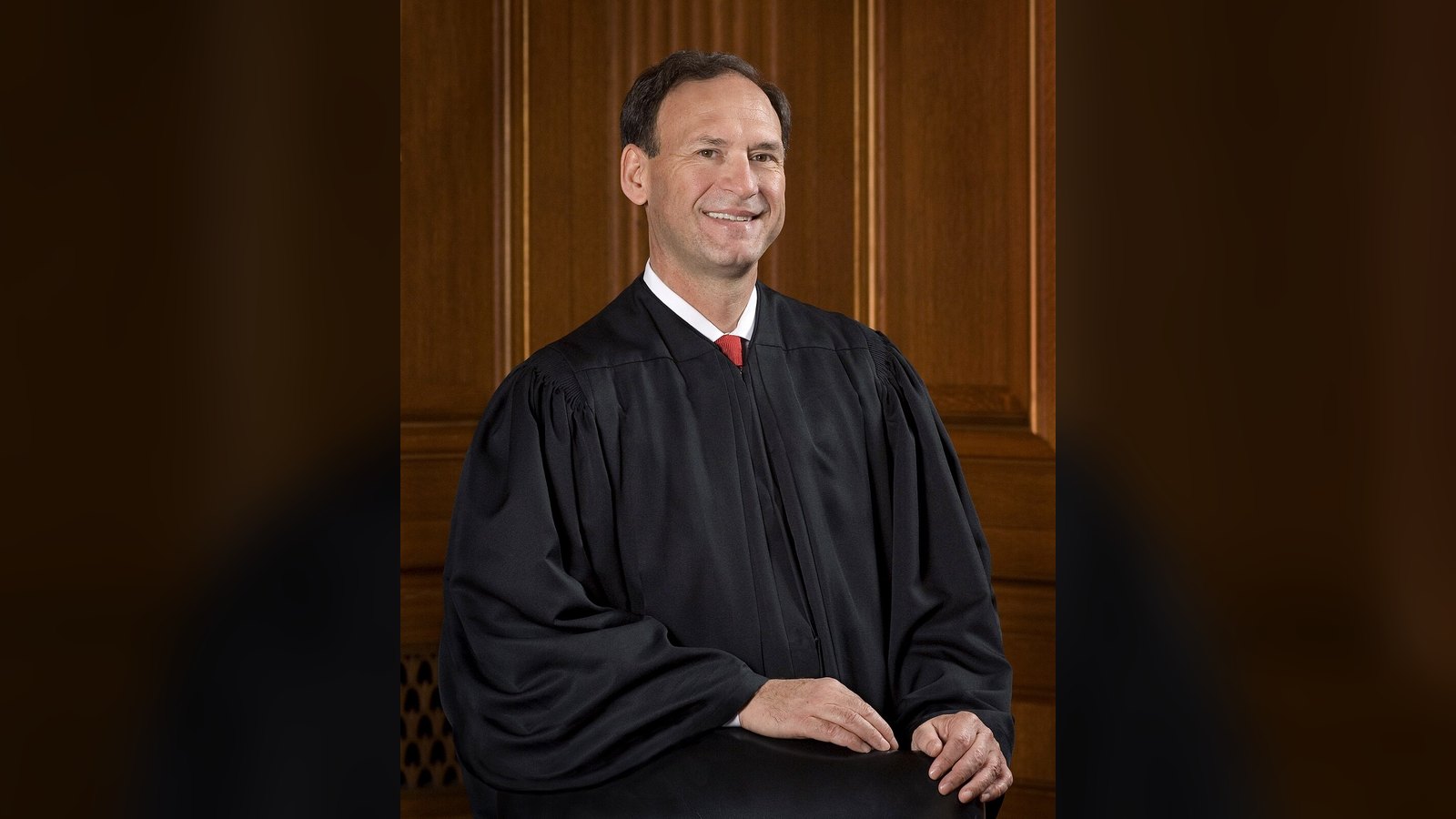
Last updated: 16 November 2026. Career details are from the Supreme Court’s official biography, the Department of Justice résumé archive and the Senate roll call record; opinions and vote lineups are from the slip opinions on supremecourt.gov and the Legal Information Institute; retirement reporting is attributed to NPR, The Wall Street Journal (via SCOTUSblog), Bloomberg News, CBS News and The New York Times, with dates.
Short answer: Justice Samuel Alito, 76, is still serving on the US Supreme Court as of 16 November 2026. He told Bloomberg News he intends to “stick around through this term”, which ends in mid-2027, and The New York Times reported after the November 2026 midterms that he did not plan to retire immediately. His legacy rests on Dobbs, Janus and Hobby Lobby.
Key takeaways
- Alito was born in Trenton, New Jersey, on 1 April 1950, studied at Princeton and Yale Law School, served on the Third Circuit from 1990 and was confirmed to the Supreme Court by 58 votes to 42 on 31 January 2006.
- He wrote the majority opinions in Dobbs v. Jackson Women’s Health Organization (2022), which overruled Roe v. Wade, Janus v. AFSCME (2018) and Burwell v. Hobby Lobby (2014).
- In the 2025 to 2026 term he wrote Louisiana v. Callais on the Voting Rights Act and Wolford v. Lopez on gun carry rules, and dissented in the mail ballot and birthright citizenship cases.
- Retirement talk peaked in 2026: NPR wrongly reported his retirement on 30 June, then retracted it, and Alito has since said he is staying at least until the current term ends.
Who is Justice Samuel Alito?
Samuel A. Alito Jr. is the second most senior associate justice, after Clarence Thomas, and at 76 the second oldest member of the Court. According to his official Supreme Court biography, he was born in Trenton, New Jersey, on 1 April 1950. He earned an A.B. from Princeton University in 1972 and a J.D. from Yale Law School in 1975.
Almost all of his pre-judicial career was spent as a government lawyer, much of it in the Reagan Justice Department. That background shows in his opinions, which tend to give weight to the practical position of prosecutors, states and religious objectors.
| Years | Role |
|---|---|
| 1976 to 1977 | Law clerk to Judge Leonard I. Garth, US Court of Appeals for the Third Circuit |
| 1977 to 1981 | Assistant US Attorney, District of New Jersey |
| 1981 to 1985 | Assistant to the Solicitor General, US Department of Justice |
| 1985 to 1987 | Deputy Assistant Attorney General, US Department of Justice |
| 1987 to 1990 | US Attorney, District of New Jersey |
| 1990 to 2006 | Judge, US Court of Appeals for the Third Circuit (nominated by President George H.W. Bush in February 1990, confirmed in April 1990) |
| 2006 to present | Associate Justice of the Supreme Court |
President George W. Bush nominated him on 31 October 2005 to succeed Justice Sandra Day O’Connor. The Senate roll call shows he was confirmed on 31 January 2006 by 58 votes to 42, and he took his seat the same day.
What are Alito’s most important majority opinions?
Over two decades Alito has written for the Court in several cases that changed the law in a lasting way. The table lists the best known, with the vote and what the Court held. Lineups are taken from each opinion’s syllabus.
| Case | Decided | Vote | What the Court held |
|---|---|---|---|
| Ledbetter v. Goodyear Tire & Rubber Co. | 29 May 2007 | 5 to 4 | A Title VII pay discrimination charge was out of time because it was filed long after the pay decisions were made. Congress reversed the result with the Lilly Ledbetter Fair Pay Act of 2009. |
| McDonald v. City of Chicago | 28 June 2010 | 5 to 4 | The Second Amendment right to keep and bear arms applies to state and local governments. |
| Burwell v. Hobby Lobby Stores, Inc. | 30 June 2014 | 5 to 4 | Closely held for-profit companies can claim religious exemptions under the Religious Freedom Restoration Act from the federal contraceptive coverage rule. |
| Janus v. AFSCME | 27 June 2018 | 5 to 4 | Public-sector unions cannot charge agency fees to non-members without their consent; Abood (1977) was overruled. |
| Dobbs v. Jackson Women’s Health Organization | 24 June 2022 | 6 to 3 on the judgment | The Constitution does not confer a right to abortion; Roe v. Wade and Planned Parenthood v. Casey were overruled. |
| Louisiana v. Callais | 29 April 2026 | 6 to 3 | The Voting Rights Act did not require Louisiana to draw a second majority-minority district, so its map was an unconstitutional racial gerrymander. |
| Wolford v. Lopez | 25 June 2026 | 6 to 3 | Hawaii’s default ban on carrying handguns on private property open to the public, without the owner’s express permission, violates the Second Amendment. |
Dobbs. Alito’s opinion in Dobbs was joined by Justices Thomas, Gorsuch, Kavanaugh and Barrett. Chief Justice Roberts agreed that Mississippi’s 15-week law should stand but would not have overruled Roe, so the vote to overrule was 5 to 4. The opinion’s method, asking whether a claimed right is “deeply rooted in this Nation’s history and tradition”, is now a reference point in other areas of constitutional law. Our explainer on stare decisis covers how the Court justified departing from a 49-year-old precedent. Alito told CBS News in October 2026 that Dobbs was the leading example of a decision that “required courage by all of the justices in the majority”.
Hobby Lobby and Janus. In Hobby Lobby, joined by Roberts, Scalia, Kennedy and Thomas, Alito read the Religious Freedom Restoration Act to protect family-owned companies, not just individuals and non-profits. In Janus, he held that compulsory agency fees violate public employees’ free speech rights, which ended compulsory fee arrangements for public employees across the country. Both cases show a pattern: strong protection for religious and speech claims, combined with a willingness to overrule precedent he considers badly reasoned.
For where these rulings sit among the Court’s most cited decisions, see our list of 50 landmark Supreme Court cases.
Which dissents define Alito’s record?
Alito’s dissents are often sharper than his majority opinions, and several are cited as much as the rulings they opposed.
- Snyder v. Phelps (2011). He was the only dissenter when eight justices held that the First Amendment protected members of the Westboro Baptist Church from tort liability for picketing near a military funeral.
- Obergefell v. Hodges (2015). He wrote one of four dissents, joined by Scalia and Thomas, arguing that the Constitution leaves the definition of marriage to the states.
- Learning Resources v. Trump (20 February 2026). He joined Justice Kavanaugh’s dissent, with Thomas, when the Court held that the International Emergency Economic Powers Act does not let the President impose tariffs.
- Watson v. Republican National Committee (29 June 2026). He wrote the main dissent, joined by Thomas and Gorsuch and largely by Kavanaugh, when a 5 to 4 majority led by Justice Barrett held that federal law does not stop Mississippi counting mail ballots that arrive up to five days after election day.
- Trump v. Barbara (30 June 2026). He filed his own dissent when the Court held that children born in the United States to parents who are unlawfully or temporarily present are citizens at birth. Our guide to Trump v. Barbara sets out each opinion.
He was in the majority in the term’s biggest separation of powers case, Trump v. Slaughter, joining Chief Justice Roberts’s opinion that lets the President remove Federal Trade Commission commissioners at will.
What has actually been reported about Alito retiring?
Speculation grew through 2026 while Republicans held both the White House and the Senate, because a retirement while that lasted would let President Trump choose a successor with a friendly Senate. What Alito himself has said, and what reputable outlets have reported, is narrower than the headlines.
| Date | Source | What was reported |
|---|---|---|
| 30 June 2026 | NPR | NPR published a story saying Alito was retiring, on the last day of the term. It was taken down within minutes. NPR’s public editor said correspondent Nina Totenberg had misheard a comment about “retirement announcements”; the network said: “Alito is not retiring. The story was wrong.” |
| August 2026 | The Wall Street Journal, reported by SCOTUSblog on 10 August | In an interview with James Taranto, Alito said: “Obviously I’m here for another term.” He likened calls for him to step down to vultures circling, and said that “goes with life tenure”. |
| 6 October 2026 | Bloomberg News (Greg Stohr) | In an interview recorded on 30 September, Alito said: “I intend to stick around through this term. I made that decision many months ago.” Bloomberg reported he intended to stay even if Democrats won the Senate. |
| 5 October 2026 | CBS News (Jan Crawford) | Alito said of retiring, “I thought about it”, and that it is “something I think that somebody at my age has to think about every term”. He said presidential politics should not drive the decision. His first book, So Ordered, a collection of speeches, was published on 6 October. |
| 4 November 2026 | The New York Times (Ann E. Marimow) | After Democrats won control of the Senate in the 3 November midterms, two people close to Alito said he had told friends he did not intend to retire immediately. Alito did not respond to the Times’s request for comment. |
The NPR public editor’s account and the CBS News interview are the most direct sources. Read together, the reporting supports three points and no more: Alito considered retiring at the end of the 2025 to 2026 term, decided to stay, and has committed only to the term that ends in late June or early July 2027. No outlet has reported a date or a decision beyond that.
What would happen if Alito retired?
A justice can retire at any time, and often announces it to take effect when a successor is confirmed. The President nominates, the Senate Judiciary Committee holds hearings, and the full Senate confirms by a simple majority. The Senate elected on 3 November 2026 takes office in January 2027, and The New York Times described the result as a commanding Democratic win, so a vacancy arising after that point would go to a Senate controlled by Democrats.
That arithmetic explains why some conservatives urged him to leave in mid-2026 and why legal commentators have compared the debate with Justice Ruth Bader Ginsburg’s decision not to retire before 2016. It does not tell us what Alito will do. His own statements say the question is reviewed term by term.
A replacement would change the Court’s internal balance even if the new justice were also conservative. Alito has been part of the conservative majority in most of the Court’s closest ideological cases, and our analysis of Justice Amy Coney Barrett’s swing votes shows how often outcomes in 2025 to 2026 turned on one or two votes.
What is Alito’s legacy so far?
Three strands are likely to outlast him. First, history-based constitutional interpretation: Dobbs and McDonald both ask whether a claimed right is deeply rooted in the nation’s history and tradition, a test that now frames arguments about other unenumerated rights. Second, religious liberty: from Hobby Lobby onwards, he has pushed for broad exemptions from general laws. Third, a willingness to overrule precedent, seen in Janus and Dobbs.
His critics point to the same record, above all Dobbs, which returned abortion regulation to the states. In 2026 he also found himself on the losing side in the mail ballot, tariff and birthright citizenship cases. Whatever his timing, his opinions have already moved US law further than those of most justices of his era.
This article is general information about Justice Samuel Alito’s career, opinions and reported plans as of 16 November 2026, not legal advice. Retirement reporting is attributed to the outlets named and may change.
Frequently asked questions
Is Justice Samuel Alito retiring?
Not as of 16 November 2026. He told Bloomberg News he intends to stay through the current term, which ends in mid-2027, and The New York Times reported on 4 November 2026 that he had told friends he would not retire immediately.
How old is Justice Alito?
He was born on 1 April 1950, so he is 76. He is the second oldest justice after Clarence Thomas, who is 78.
Who appointed Samuel Alito to the Supreme Court?
President George W. Bush nominated him on 31 October 2005 to replace Justice Sandra Day O’Connor. The Senate confirmed him by 58 votes to 42 on 31 January 2006.
Did Alito write the Dobbs opinion?
Yes. He wrote the majority opinion in Dobbs v. Jackson Women’s Health Organization, decided on 24 June 2022, which overruled Roe v. Wade and Planned Parenthood v. Casey.
Did NPR report that Alito was retiring?
Yes, briefly, on 30 June 2026. NPR retracted the story within minutes, saying its reporter had misheard a bystander, and its public editor wrote: “Alito is not retiring. The story was wrong.”
What did Alito decide in the 2025 to 2026 term?
He wrote the majority opinions in Louisiana v. Callais on the Voting Rights Act and Wolford v. Lopez on Hawaii’s carry rules, joined the majority in Trump v. Slaughter, and dissented in Watson v. RNC and Trump v. Barbara.
Featured image: Photo: Collection of the Supreme Court of the United States, photographer Steve Petteway, via Wikimedia Commons, public domain (adapted)
Where the legal industry reads first.
Enjoyed this article? Get the biggest legal industry updates, deals, appointments, insights and expert interviews in your inbox, free.
No spam. Unsubscribe anytime.From Legal Desire
Is your firm the one being cited, or the one being skipped?
We ran the test. On several everyday legal questions, software companies are answering and law firms are not. We help firms fix that, and we build the technology behind the practice.
Lawyers and firms: get featured on Legal Desire
Share your deals, lateral moves, firm news and insights with 1M+ monthly readers: founders, law firm partners, general counsel and practising lawyers across the US, UK, EU and GCC.
Get featuredSubmit a press release