
Introduction
The advances in science have led to better ways for criminal investigations, and they allow investigators to get information that isn’t possible during an interrogation. Of these, polygraph testing, narcoanalysis, and brain mapping have garnered a lot of interest as possible tools to use when determining whether or not a person is lying, what they know if they are lying, and when investigating. Whereas conventional forensic techniques, such as fingerprints or DNA, rely on evidence that is either physiological, psychological or neurological, the techniques rely on these areas to suggest whether a person recognises or possesses information pertaining to a crime scene (Math, 2011).
In the polygraph, the person takes a series of questions and his or her heart rate, blood pressure, respiration and skin conductivity are measured. Narcoanalysis: a sedative drug used to create a semi-conscious condition in a person to release information. Brain Mapping, or Brain Electrical Activation Profile (BEAP) test, is designed to detect what information a person recognizes within the brain, but not deception itself. (Math, 2011).
About: Polygraph, Narcoanalysis, Brain Mapping.
The increasing sophistication of crime has inspired policymakers to increasingly use scientific tools that have the potential to aid in criminal investigations and to decrease the use of coercive interrogation techniques. Of all these techniques, polygraph testing, narcoanalysis, and brain mapping the last two are combined to form what is called Deception Detection Tests (DDTs). Their goal is not to prove someone guilty but to provide investigative leads via either physiological/neurological information or reaction to concealed information. The techniques became fashionable in India as alternatives to third-degree interrogation, and the constitutionality and scientific validity of these techniques continue to be debated (Kamath, 2012; Buchiya, 2019)
- Polygraph Test
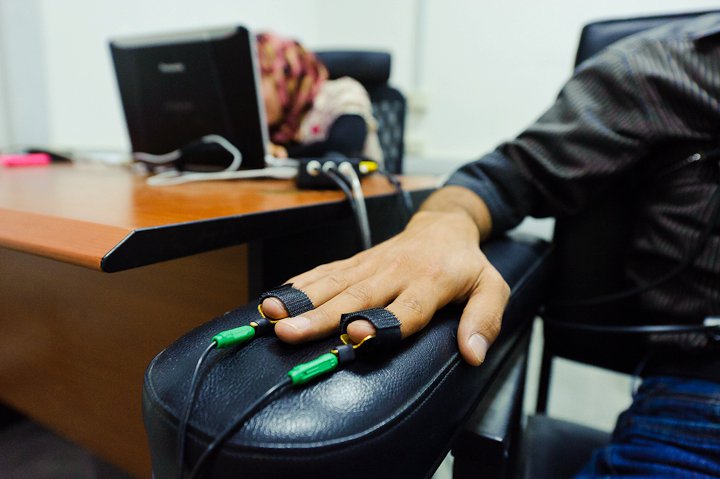
The polygraph test, or “lie detector” test, is based on the assumption that psychologically stressful answers to deceptive questions lead to measurable physiological changes. In the course of the examination, the parameters are continuously recorded by sensors attached to the person being examined, while the person responds to a series of carefully formulated questions; these parameters include heart rate, blood pressure, breathing activity, GSR (galvanic skin response) and, in certain systems, muscle activity (EMG). As the responses are made, they are recorded and subsequently analysed by a trained examiner to establish if any significant physiological reactions are made in relation to the relevant questioning. The scientific foundations for the polygraph arose from the studies of Cesare Lombroso, who used blood pressure as an indicator of deception and later those of William Marston and John Larson, both of which helped develop the modern polygraph instrument (Buchiya, 2019)
Although it is used widely for investigations, the validity of the polygraph has been called into question. Physiological reactions can be due to factors other than deception, such as nervousness, fear, anxiety, depression, medical condition, fatigue or drug effect. Furthermore, some research indicates that the trained person may be able to alter the body’s reaction by relaxation exercises or specific breathing patterns, which decreases the validity of the exam. As such, the polygraph is considered to be an investigative tool and not a conclusive scientific instrument for proving a person is telling the truth. (Buchiya, 2019)
- Narcoanalysis
Narcoanalysis: Investigative technique using sedation, usually sodium thiopental (sodium pentothal), to put a person in a semi-conscious or hypnotic state. The subject is thought to have lowered their guard and less ability to knowingly produce answers, so investigators hope to learn the secret information. Because of this “effect,” sodium thiopental is traditionally known as a “truth serum”. The drug was originally designed as an anaesthetic, but it was later used during the Second World War as an interrogation agent, and in some criminal investigations (Buchiya, 2019).
But today’s scientific studies have shown that narcoanalysis does not ensure confessions. Sedation can make people extremely susceptible to suggestion, confused, have false recollections, and give false answers to blatant questions. Statements made in this state of diminished mental capacity are not necessarily truthful and are not of their own making; independent corroboration must be obtained in all cases by relying on material evidence that can be used in court (Kamath, 2012)
- Brain mapping (Brain Electrical Activation Profile).
Brain Mapping or the Brain Electrical Activation Profile (BEAP) test, which is also referred to as the P300 test, is a neuro-physiological test which measures the electrical activity produced by the brain using electroencephalography (EEG). While the subject is being tested, the stimuli presented, whether visual, auditory or textual, are related to or neutral to crime and electroencephalograms are taken to measure event-related potentials, specifically the P300 wave, which is thought to represent familiar information recognition. The brain mapping is not designed to recognize lying, but to determine if brain information is already stored to details of a crime (Jhingan et al., 2025).
However, criminal information in its recognition does not establish guilt. These brain responses can be observed in a witness, an investigator or anyone who has been exposed to news reports about the crime, since the test is for the memory to recognize the image of the face of the actual criminal and not for the memory to know of a crime. Hence, brain mapping can furnish helpful investigative leads; it cannot alone establish culpability or prove to be convincing evidence of guilt (Kamath, 2012).
Although these are investigative, the scientific validity and legality of these techniques are still much disputed. The Supreme Court of India in the case of Selvi & others v State of Karnataka (2010) declared that the test of “voluntary” administration is a fundamental requirement when using these tests in India and that these tests breach the Constitution of India by infusing information about the test taker’s behaviour into the court records.
The legal status of Polygraph, Narcoanalysis and brain mapping in India.
Polygraph test, Narcoanalysis, and brain mapping are some of the most controversial techniques in Indian criminal justice. These techniques are sometimes used to help with criminal investigations, but they have a lot associated with them that raise constitutional, ethical and human rights concerns. The key question is whether a person’s right to freedom from self-incrimination (Article 20(3) of the Constitution of India, 1950) and his constitutional right to life and personal liberty (Article 21, Constitution of India, 1950) are violated by forced exams.
The Supreme Court of India, in the landmark case, Selvi & Others v State of Karnataka, 2010, has put the matter to bed once and for all with regard to the constitutionality of the investigative methods. The case came up after a series of accused persons protested against the use of compulsory polygraph, narcoanalysis, and brain mapping tests by investigating agencies. The petitioners contended that compelling a person to go through these procedures was a violation of the right to self-incrimination in the Constitution, and constituted testimonial compulsion. The Court was also naturally asked to decide the issue of whether such involuntary examinations infringed upon the principles of personal liberty, privacy and human dignity enshrined under Article 21 (Selvi v. State of Karnataka, 2010).
The Supreme Court’s historic ruling on 5 May 2010 declared the compulsory administration of polygraph examinations, narcoanalysis and brain mapping tests to be unconstitutional. The Court noted that the methods used are those of extracting from a person’s mind personal knowledge without his or her free will, which in turn infringes the protection against self-incrimination guaranteed by Article 20(3). Moreover, it was held that compulsion of such processes would be detrimental to the fundamental rights of mental privacy and bodily integrity, which are necessary components of Article 21 (Selvi v. State of Karnataka, 2010) right to life and personal liberty guaranteed by the Constitution.
But the Court did not rule these methods of linkage to be completely banned. Clarified that they can only be administered on the basis of the free, informed and voluntary consent of the person concerned. In these circumstances, however, the results obtained from these tests cannot be used as substantive evidence to appear in front of a court of law, as the scientific quality of these tests is still unclear. However, if any material evidence is found after giving voluntary information, it could be admissible under the Indian Evidence Act, 1872, provided it meets the conditions laid down by the law.
The judgment also affirmed the National Human Rights Commission (NHRC) Guidelines (2000) which outline the procedural protections of conducting a polygraph examination. These include securing written informed consent, making the legal implications of the examination clear, providing access to legal representation, having the examination carried out by competent medical personnel and proper audio and video documentation of all the procedures, among others. These protections are designed to strike a balance between investigations and constitutional rights and human rights.
The legal situation in India is now settled. The polygraph test, narcoanalysis, and brain mapping are considered investigative tools, rather than proof of guilt. The use of these techniques by investigating agencies is only permissible where they have first sought consent and as long as constitutional safeguards are observed. Courts are still largely tasked with relying upon independently acquired evidence, and the findings of these examinations are used as a means to help them investigate, but do not constitute grounds for criminal convictions.
References:
- Math, S. (2011). Supreme Court judgment on polygraph, narco-analysis & brain-mapping: A boon or a bane. The Indian Journal of Medical Research, 134, 4- 7.
- https://cdnbbsr.s3waas.gov.in/s3ec0490f1f4972d133619a60c30f3559e/documents/aor_notice_circular/26.pdf (https://www.sci.gov.in/)
- National Research Council. 2003. The Polygraph and Lie Detection. Washington, DC: The National Academies Press. DOI: https://doi.org/10.17226/10420
- Kamath, V. J. (2012). Narcoanalysis, Polygraph and Brain-Mapping as a Tool of Evidence Vis-À-Vis Fundamental Rights.
- Buchiya, M. L. K. (2019). Use of Polygraph and Narcoanalysis Tests in India: A Legal Perspective.
- Jhingan, A., Parameshwaran, P., & Verma, Y. (2025). BRAIN MAPPING IN CRIMINAL JUSTICE: A MEDICO-LEGAL ANALYSIS. Available at SSRN 5205284.
- https://www.legislative.gov.in/
- https://nhrc.nic.in/
Where the legal industry reads first.
Enjoyed this article? Get the biggest legal industry updates, deals, appointments, insights and expert interviews in your inbox, free.
No spam. Unsubscribe anytime.From Legal Desire
Is your firm the one being cited, or the one being skipped?
We ran the test. On several everyday legal questions, software companies are answering and law firms are not. We help firms fix that, and we build the technology behind the practice.
Lawyers and firms: get featured on Legal Desire
Share your deals, lateral moves, firm news and insights with 1M+ monthly readers: founders, law firm partners, general counsel and practising lawyers across the US, UK, EU and GCC.
Get featuredSubmit a press release