
When you have clothes like designer outfits, special one-of-a-kind pieces, old fabrics, fancy sarees, clothes with embroidery and limited edition fashion items, they can be very valuable. If you insure these clothes and something bad happens,s like a fire, smoke, flood or water damage, you can get a lot of money from the insurance company. Because these items are so valuable, some people might try to fake or exaggerate their claims to get more money. For example, someone might damage a garment on purpose. Say it was an accident, or they might say old damage was caused by something that just happened.
That is where looking closely at the clothes becomes important. By checking the threads, colors, how the fabric is made, stains and how the fabric is falling apart, we can figure out what happened to the clothes and how it got damaged. We do not just look at the clothes. Guess what happened. We use tools and tests to get a good idea of what is going on. Some studies have shown that by looking at how the fabric is damaged, we can get some ideas about what happened, but we have to be careful and consider all the possibilities.
When we are investigating an insurance claim, we do not just look at the clothes. We also look at pictures, receipts, insurance papers, what people say happened, evidence from the scene of the fire or flood and information from experts and investigators. We put all these things together to get a picture of what really happened to the expensive clothes, like designer clothing and luxury sarees.
Why Textile Evidence Matters in Insurance Fraud
Insurance fraud involving clothes can happen in different ways. A person might purposely burn an expensive piece of clothing to get the money from the insurance. They might also make it look like the clothing got wet from water. Say that a small problem is much bigger than it is. Another thing is someone might say that an old piece of clothing was bought recently. There is also a chance that an accident really happened. The person says the damage is worse or more expensive than it actually is.
Forensic textile analysis can address questions such as:
- Is the reported damage consistent with exposure to fire?
- Was the garment actually exposed to significant heat?
- Does the pattern of burning correspond with the claimed fire scenario?
- Are smoke and combustion residues consistent with the reported inciden
- Is water damage consistent with immersion, flooding or prolonged moisture?
- Could the observed deterioration have existed before the claimed incident?
- Has the garment been washed, chemically treated, artificially aged or otherwise altered after the event?
- Are different portions of the garment consistent with the same damage event?
The purpose is not necessarily to declare that a claimant has committed fraud. Instead, the expert provides scientific observations that can support or contradict the proposed explanation.
Initial Examination and Documentation
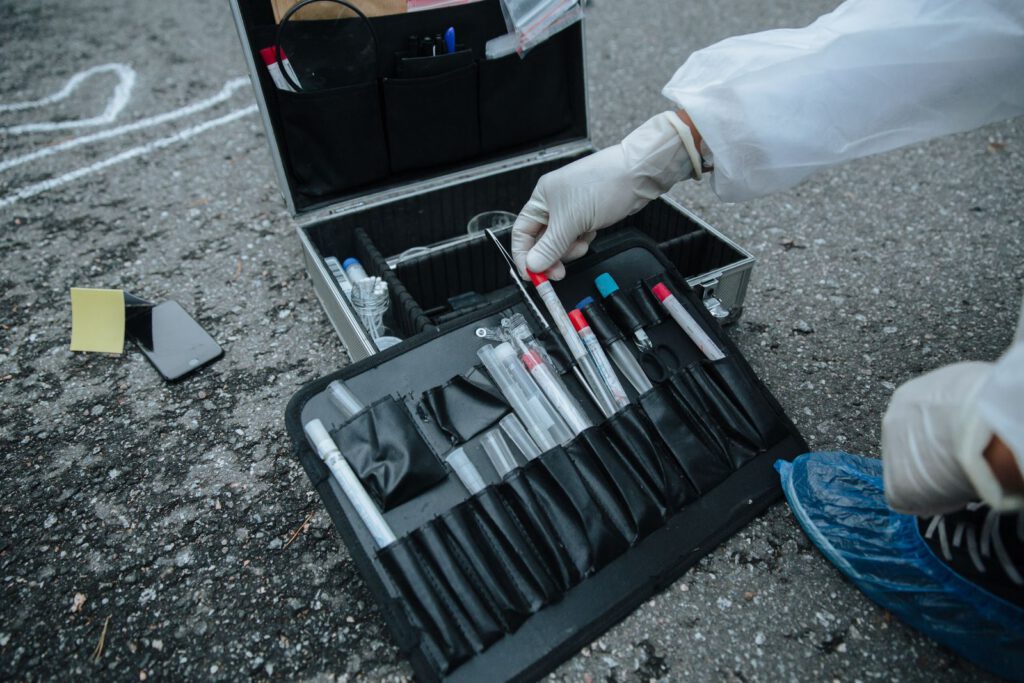
The exam starts with taking notes. Investigators take pictures of the clothing before touching it, noting how it looks overall, where it’s torn, the labels, the stitching, any fancy designs, the buttons, any extra parts and other things that can help identify it.
The state of the clothing is written down using pictures, measurements and words. Extra care is given to where the damage is and how it’s spread out. A small burn, for example, might tell a story more than if the whole clothing was burned evenly.
The expert might also look at the damaged clothing. Compare it to pictures taken before the event, receipts, info from the maker, photos from when it was appraised or a part of the same clothing that’s still in good shape.
Handling the evidence the right way is very important. The clothing needs to be put in a bag or box and moved in a way that stops dirt from getting on it or water from building up or the clothing from getting worse. If parts are taken for testing, where they were taken from should be written down so people can see where the findings came from on the clothing.
Examination of Fibres
Fibres are really important when it comes to figuring out things about clothes and fabrics in investigations. A piece of clothing can have fibres like cotton, wool, silk and linen, or it can have synthetic fibres like polyester, nylon and acrylic. Some fabrics are made from a mix of fibre types.
Experts look at fibres closely using special tools like microscopes and other methods to see what they are made of and how they are put together. When they do this, they look for things like the colour of the fibre, how it looks in light and what it is made of. These things can be really useful when they are trying to examine fibres.
If you look at a fibre under a microscope, you can see if it has been damaged by things like heat, fire, water, chemicals or if it has been pulled or stretched. Synthetic fibres can melt, shrink or get distorted if they get too hot. Natural fibres can get burned, change colour or fall apart.
What these findings mean depends on the fibre. If a synthetic fibre is melted, it could mean that it was exposed to a lot of heat. If the colour of a fibre has changed, it could be because of a lot of different things. Fibres are a part of textile forensic analysis, and experts use fibre examination to help them solve cases.
Detecting Genuine Fire Damage
Determining whether a garment has genuinely been damaged by fire involves more than finding a blackened or discoloured area.
Thermal Damage
People who know a lot about this stuff look at the characteristics of the damaged fibres. When heat is applied, it can make the fibres shrink, melt, stick together, become brittle, turn black and change the way they look. How much these things happen can help figure out if the garment was exposed to a lot of heat.
Different materials are affected by heat in different ways. Man-made fibres like the ones used in some clothes can become soft and melt. Fibres that come from natural things, like plants and animals, usually just get worse and worse and eventually catch on fire. So the person who is examining the damage thinks about what the garment’s made of before they try to understand what happened to it.
Burn Patterns
The way that thermal damage is spread out can tell us a lot. When a fire happens by accident, it can make patterns because of where the heat is coming from, which way the heat is going, what is around it, how the air is moving and how long it is burning.
If the pattern of damage is weird or in one small area, we need to look into it more. So experts check to see if the damage they see could really have happened the way people say the fire happened.
People who study how textiles get damaged have found out that looking at how the damage happened can help figure out what caused it, like if it was cut, heated, burned or something else. Sometimes they even try to recreate what happened to get an idea of how it worked.
Smoke and Combustion Residues
A fire-damaged garment can have soot, smoke-based deposits and materials from burning. A chemical test can help find the things that stuck to the fabric or got into it.
This is very important when someone might have started the fire on purpose or used something that can catch fire. For instance, checking fire debris in a case might use chemical methods like gas chromatography-mass spectrometry (GC-MS) to look for things that can burn easily.
Indian insurance cases show how important it is to check fire debris with science. In a 2026 insurance case, testing the fire debris found chemicals that matched kerosene near where the fire started, but not in other places. The court looked at the results along with other details instead of just believing the lab results on their own.
Another 2026 Indian insurance case had the result: testing the fire debris found no chemicals that came from something that can burn.
These examples show why scientific findings need to be understood in the situation. Not finding chemicals from something that can burn doesn’t mean a fire didn’t happen. Finding chemicals doesn’t prove who started the fire on its own.
Detecting Artificial or Deliberate Burning
One important forensic question is whether the damage pattern is consistent with the claimed accidental event.
Experts look for inconsistencies between:
- the reported source of fire;
- the location of damage;
- the degree of thermal degradation;
- the distribution of soot and residues;
- the condition of unaffected areas; and
- other physical evidence from the scene.
For example, if a piece of clothing is said to have been in a house fire but only a tiny,y clearly defined part of it has heat damage while other materials that were supposedly in the same situation have different kinds of damage, investigators might wonder if the story makes sense physically.
Forensic experts need to be careful not to say too much. Looking at damage on fabric is a type of work that relies on features and still depends a lot on what people see, experiments they do and how they interpret what they find. Recent studies have focused on ways to do this work and steps that help stop people from making mistakes in their thinking.
Forensic Examination of Water Damage
Water damage is a problem because moisture often doesn’t show up in an easy-to-spot way.
Experts start by looking at how the garment looks. Much moisture can change the way the fibres are built, the colours, the coatings, the glue, the sewing and other parts. It can also lead to living things growing, especially if the moisture stays and the garment isn’t dried quickly.
Water Staining and Distribution
The location and pattern of water staining can tell us a lot. Water can make tide lines on things. The colour can look different depending on what the thing is made of and what kind of dye it has. The water can also have dirt and other things in it that change the way it stains.
An expert will look at the pattern of the water staining. Think about if it matches what people say happened. For example, if the whole thing got wet or just part of it got wet, or if water got on it from the top or just in one spot where it touched water. The expert will think about the water staining. If it looks like it was made by water getting on the thing in the way that people say it did. The water staining is very important to the expert because it can help figure out what really happened to the thing and how the water got on it.
Clean Water Versus Contaminated Water
Not all water damage is the same. Floodwater can have soil, minerals, small pieces of plant material, things from sewage or other things. These things can get stuck inside the parts of fabric.
Looking closely and checking with chemicals can find small pieces or things that build up, which can help show what happened.
If someone says an expensive piece of clothing was in floodwater,r but the clothing has very little or no small pieces from that water, experts might think of other reasons. Washing, rinsing, and other treatments can take away or change those signs, so not finding any signs doesn’t always mean the story is not true.
Dye and Colour Analysis
Luxury clothes often have special dyes. Fire, water, soaps, bleach and other chemicals can change how they look.
Methods like microspectrophotometry, infrared spectroscopy and chromatography can help look at dyes and fabric parts.
The expert can look at the damaged part and the undamaged part of the piece of clothing. If the damaged part has changes in chemicals or light that match what was said to happen, this can back up the story.
On the other hand, strange differences can show that the colour change came from a different cause. For example, bleaching or chemical treatment might make changes that look like some kinds of water or weather damage.
Microscopy and Spectroscopy
Microscopy is one of the techniques in textile examination. It lets experts look at fibers, yarns, weave patterns, surface dirt and how damage looks.
Spectroscopic methods give information about the chemicals. Fourier-transform infrared spectroscopy (FTIR) can help understand polymeric fibres and other materials. Different spectroscopic techniques can be used based on the material and the question.
These methods are very helpful when the clothing is made of different materials. A high-end piece of clothing might have fabric, synthetic lining, metal threads, glue, leather parts, special coatings and unique dyes. Each part can act differently when exposed to heat and water.
Comparing Damaged and Undamaged Areas
One of the methods is internal comparison.
Then, by looking only at the part that is damaged, specialists can compare it with an area that seems not damaged at all from the same clothing. This helps control things like the material type, how it was made, the colour, and how old it is.
For instance, if the fibres in a part that is said to be burned show a lot of heat damage while the fibres in an area that was protected still look the way they should, that difference could show that real heat was involved.
The way changes caused by water can be looked at between the part that was exposed and the part that was more protected.
Establishing Pre-existing Damage
One of the most important aspects of a claim under a policy of insurance is to find out whether the damage was present before the occurrence of the event in question. The effects of wear can result in frays, fades, breaks, scuffing and weakening of seams. However, this type of damage might be wrongfully attributed to an event that recently took place. As a result, specialists assess the morphology of damaged fibres and their surroundings in order to gather more information. The condition of seams and stitching is one of the biggest sources of information about the history of the garment.
Experimental Reconstruction
When we are not really sure how something works, it can be helpful to do some testing. People who study this have used tests to look at how different things like heat, fire and rough handling can hurt clothes.
In a situation where someone is looking into something for insurance, they might take a piece of cloth that’s similar to the one that got hurt and see what happens when they make it go through the same things. They do this to figure out if what people are saying about how it got hurt could really be true.
This kind of testing needs to be planned carefully. The cloth they use for the test should be as close as possible to the thing in terms of what it is made of, how it is woven, how heavy it is, what colour it is and how it is treated. If the test cloth is not similar enough to the cloth, it could give us wrong ideas about what really happened to the textile material.
Integration With Insurance Investigation
Forensic textile analysis is merely one part of a highly advanced insurance investigation.
The expert’s conclusions may also be checked against: invoices and receipts; images of the clothing prior to the event; valuation and assessment papers; insurance documents; CCTV footage; fire brigade papers; electrical study papers; images of the site of the event; weather conditions; records of cleaning or restoration; and witness statements.
This integrated approach is very significant as it is unlikely that fraud is proved based on just a single laboratory test. In a recent Indian insurance case, the forensic evidence was scrutinised together with procurement records, insurance situation and other data relating to the case at hand.
Limitations of Forensic Textile Analysis
Textile analysis is really useful. It has some problems. Fire can get rid of information, and water or cleaning can remove things that are left behind on a piece of clothing. A piece of clothing can also be affected by a lot of things over time.
For example, a lot of things can happen to a piece of clothing that can make it look a certain way. It can get stained, or it can shrink or fall apart. These things can happen for reasons
So an expert in textile analysis needs to be careful when they are looking at evidence. They need to think about what the evidence’s actually showing, what it might be suggesting and what it is not telling us. Experts who study science today say that we need to use methods that have been tested, organise the information in a systematic way and be aware of our own biases when we are trying to figure out what happened to a piece of clothing.
Forensic Relevance
Forensic textile analysis provides an important bridge between material science and insurance investigation. A high-value garment can contain a considerable amount of physical information about the event that damaged it. Fibre morphology, thermal effects, stains, residues, dye changes and patterns of degradation can collectively help reconstruct what happened.
In suspected fire claims, examination may help establish whether thermal damage is genuine, whether combustion residues are present and whether the observed pattern is compatible with the reported event. In suspected water claims, experts can evaluate staining, particulate contamination, fibre changes and deterioration patterns.
Most importantly, forensic textile examination does not simply answer the question, “Is this garment damaged?” The more important question is “Is the type, distribution and severity of damage consistent with the event described in the insurance claim?”
Conclusion
The investigation of insurance claims about expensive clothes is getting a lot of help from science that looks at clothes really closely. A piece of clothing that looks like it has been burned, got wet or changed color might seem like nothing. It can have tiny clues and chemical signs that can be used to question or support what really happened.
Experts use a lot of methods to figure out what is going on. They write down everything they see, look at the fibres under a microscope, use tools to see what the clothing is made of, check for chemical signs, look at how the damage happened and compare the damaged and undamaged parts. Sometimes they even try to recreate what happened to see if it matches the story. This helps them decide if the damage from fire or water is real or not.
It is really important to remember that clues from clothes should not be looked at by themselves. The best answers come when the results from the laboratory are combined with evidence from the scene, documents, pictures and the rest of the insurance investigation. When it is done correctly, looking at clothes in a way can help insurance companies tell if someone is being honest about what they lost. It can also give courts and investigators evidence that is based on science. This helps them figure out what really happened and make decisions.
Where the legal industry reads first.
Enjoyed this article? Get the biggest legal industry updates, deals, appointments, insights and expert interviews in your inbox, free.
No spam. Unsubscribe anytime.From Legal Desire
Is your firm the one being cited, or the one being skipped?
We ran the test. On several everyday legal questions, software companies are answering and law firms are not. We help firms fix that, and we build the technology behind the practice.
Lawyers and firms: get featured on Legal Desire
Share your deals, lateral moves, firm news and insights with 1M+ monthly readers: founders, law firm partners, general counsel and practising lawyers across the US, UK, EU and GCC.
Get featuredSubmit a press release