

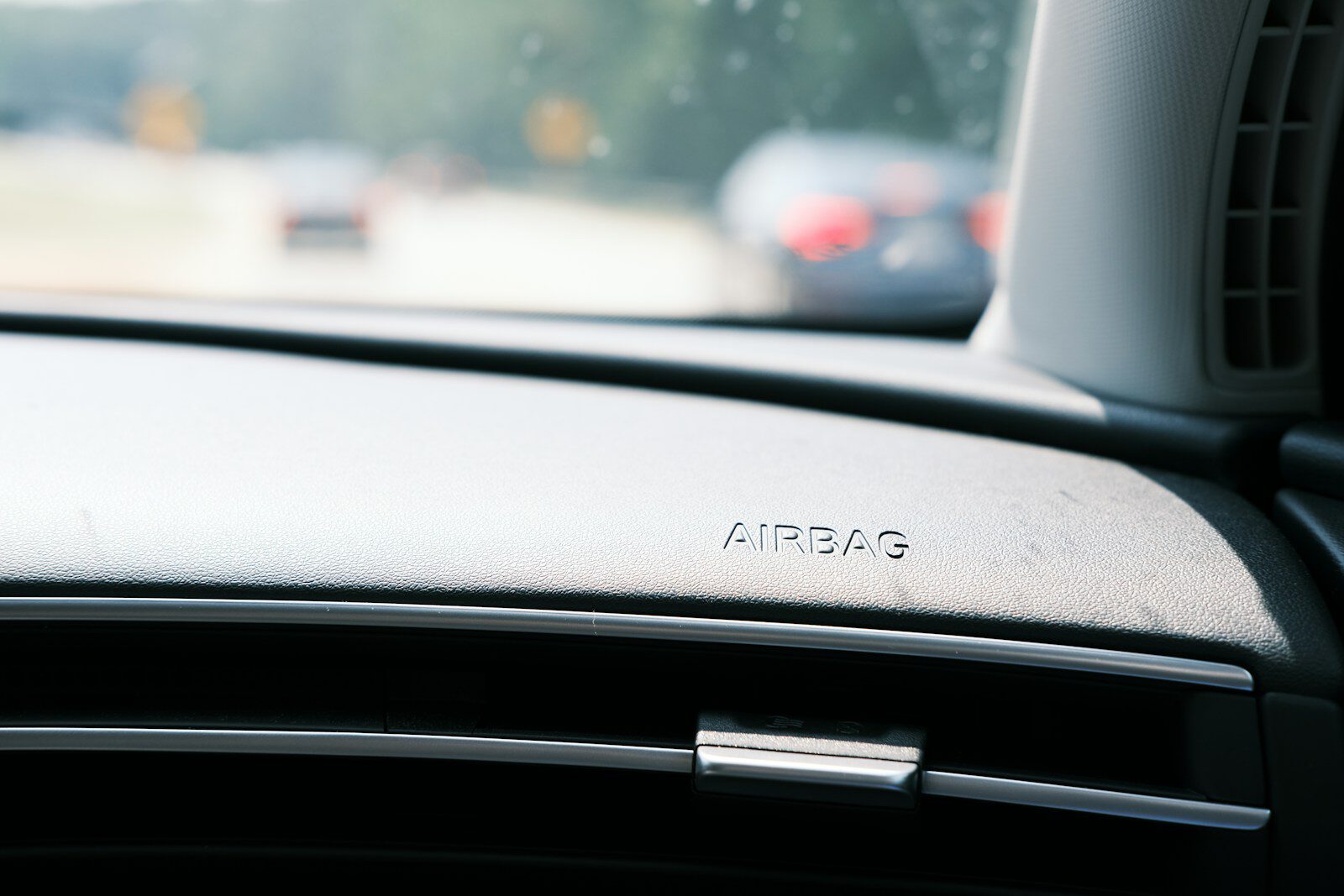
Picture a thin nylon bag folded tighter than a road map, tucked inside your steering wheel. It might sit there untouched for fifteen years. Then, in a moderate to severe crash, it bursts outward and fills with gas faster than you can blink.
That’s not an exaggeration. Frontal airbags typically inflate in less than one twentieth of a second. In that sliver of time, sensors have to detect the crash, a computer has to decide whether it’s serious enough, and a chemical reaction has to fire instantly.
It’s a remarkable piece of engineering, and it works. Federal safety estimates credit frontal airbags with saving tens of thousands of lives. Paired with a seat belt, they cut the risk of death in frontal crashes far more than either can manage alone.
Why an Airbag Has to Inflate So Quickly
Crashes are shockingly fast. Much of a typical frontal impact plays out in a fraction of a second. The car stops abruptly, but your body keeps moving forward at full speed until something stops it. That something should be a cushion.
If the bag inflates too late, the occupant has already moved into its path, and the deploying bag can strike them with truly tremendous force. Timing is everything. The goal is a fully formed cushion waiting just as the body arrives, then deflating to absorb energy.
When that timing fails because of a faulty sensor or a flawed inflator, an airbag injuries attorney may look closely at whether the restraint system was defective. Most deployments work as designed, but a small number of failures can turn protection into harm.
The Hidden Forces Behind Airbag Deployment
It starts with sensors. Accelerometers and other crash sensors measure how quickly the vehicle slows down. An electronic control unit analyzes that data in milliseconds, deciding whether the crash is severe enough to warrant deployment or mild enough to skip it. Precision matters.
Once the decision is made, a signal fires an igniter inside the inflator. That sparks a rapid chemical reaction that produces a surprisingly large volume of gas, often mostly nitrogen. Older designs relied on sodium azide, while newer inflators use different propellant chemistry.
The gas rushes into the folded bag, bursting through a seam in the steering wheel or dashboard cover. Small vents then let gas escape as the occupant presses into the cushion, so the bag absorbs energy gradually instead of acting like a solid wall.
Why a Safety Device Can Still Cause Injuries
Anything that inflates this fast carries serious energy. Most airbag-related injuries are minor, though they can still sting. Abrasions on the face, arms, and chest are common, along with bruises where the fabric makes contact at high speed. It’s a controlled explosion, after all.
Burns can happen too. The hot gases and chemical residue released during deployment can irritate skin and eyes, and the fine powder inside many bags may trigger coughing. Some people also experience hearing problems from the loud bang of deployment. Most fade quickly.
Occupants sitting too close face greater risks, including facial fractures, eye injuries, and chest trauma. Still, those risks don’t outweigh the benefits. Modern advanced airbags adjust their force in many situations, and properly functioning systems prevent far more serious injuries than they cause.
What Happens When an Airbag Doesn’t Work as Intended
Sometimes an airbag fails to deploy when it should. A faulty sensor, damaged wiring, or a software problem can leave occupants without protection in a serious crash. The result can be head, chest, or facial injuries the bag was designed to prevent.
The opposite problem also occurs. An airbag can deploy unexpectedly in a minor bump, or even without any crash at all, startling the driver and potentially causing a loss of control. Deploying with too much force is another documented failure. Neither outcome is acceptable.
Manufacturing defects can be even more dangerous. The massive Takata recall involved inflators that could rupture and spray metal fragments into the cabin, with risk increasing after long exposure to heat and humidity. That defect led to the largest auto recall in American history.
Conclusion
Airbags are a marvel of split-second engineering. Sensors, computers, and chemical inflators work together to build a protective cushion in less time than it takes to blink, and they’ve helped save tens of thousands of lives on American roads. It’s quietly brilliant design.
Like any powerful device, they carry some risk. Abrasions, burns, and impact injuries can occur, and defective components, missing deployments, or ruptured inflators can cause serious harm. Those cases are rare compared with the protection airbags deliver every day. Benefits clearly win.
Getting the most from them is surprisingly simple. Always wear a seat belt, sit at least ten inches from the steering wheel, keep children in the back seat, check for open recalls, and never ignore an airbag warning light on the dash. Small habits matter.
Where the legal industry reads first.
Enjoyed this article? Get the biggest legal industry updates, deals, appointments, insights and expert interviews in your inbox, free.
No spam. Unsubscribe anytime.From Legal Desire
Is your firm the one being cited, or the one being skipped?
We ran the test. On several everyday legal questions, software companies are answering and law firms are not. We help firms fix that, and we build the technology behind the practice.
Lawyers and firms: get featured on Legal Desire
Share your deals, lateral moves, firm news and insights with 1M+ monthly readers: founders, law firm partners, general counsel and practising lawyers across the US, UK, EU and GCC.
Get featuredSubmit a press release