


Most problems with country expert reports are created before the expert writes a word. They come from the instruction: questions that are too broad, a deadline that leaves no room for review, or an expert whose regional coverage does not quite match the case. Each is avoidable, and each is cheaper to fix at the outset than at a hearing.
Ask the questions the tribunal will have to answer
An instruction that asks for background on the country produces a country summary. A tribunal does not need a summary; it needs answers to the contested issues in the file.
If the dispute is internal relocation, the question is whether this applicant, with this profile, could live safely in a named city, and what the record says about protection there. If the dispute is state protection, the question is whether complaints of this type are investigated in that jurisdiction, and what happens to complainants. If the dispute is whether the risk persists, the question is what has changed since the events described.
Framed that way, the report answers the case. Framed loosely, it reads as context and carries much less weight. The practical side of commissioning a country report is mostly about getting this first step right.
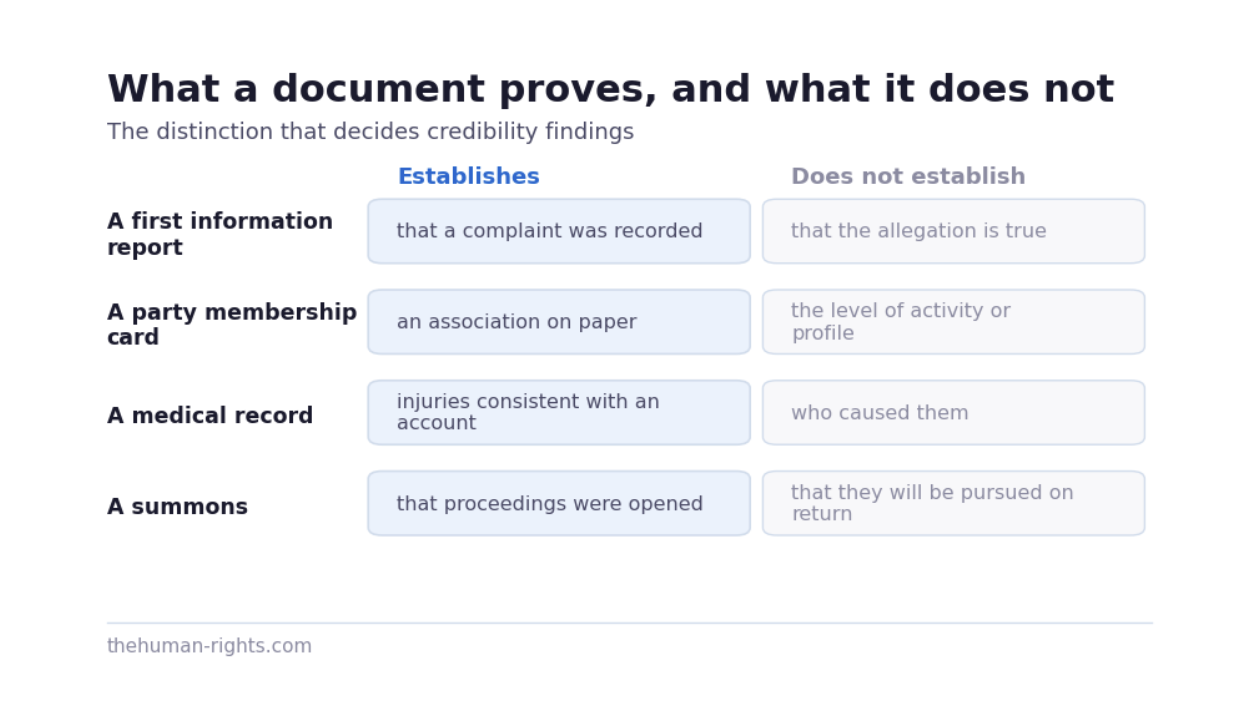
What a tribunal weighs when documents are disputed.
Match the expert to the region, not the continent
Regional coverage is often stated too broadly. An expert on West Africa may have deep knowledge of two countries and general knowledge of the rest. That is not a defect, but it matters when the file turns on a specific district.
Before instructing, it is worth checking what the expert has published, which countries they have given evidence on, and whether they have been accepted by a tribunal before. Most reputable providers list country experts by region with their backgrounds, so this check takes minutes rather than days.
Build in time to read the draft
Reports are frequently commissioned too late to be reviewed properly. A standard report takes one to two weeks, and counsel then needs time to read it against the file, identify anything that cuts the wrong way, and ask follow-up questions.
That last step is the one most often skipped. An expert who is told which point remains unclear can usually address it in a short supplementary note. An expert who first learns of the gap through cross-examination cannot.
Keep fact and opinion separable
A report should make clear what is drawn from the record and what is the expert’s assessment of it. Where sources conflict, the report should say so rather than choose silently. Where the expert cannot establish something, the report should state that too.
This is not a stylistic preference. A tribunal may accept the factual sections and question the conclusions, and a report structured so that the two can be separated survives that treatment. One in which they are blended does not.
A short checklist before sending the instruction
The questions are the contested issues, written as questions. The applicant’s profile, the relevant dates and the disputed points are included. The expert’s coverage of the specific region has been checked. The deadline leaves at least a week for review and follow-up. The fee and scope are agreed in writing before work begins.
None of this is complicated. It is simply easier to do at the start of a case than in the week before a hearing, which is when most of these questions are first asked.
Where the legal industry reads first.
Enjoyed this article? Get the biggest legal industry updates, deals, appointments, insights and expert interviews in your inbox, free.
No spam. Unsubscribe anytime.From Legal Desire
Is your firm the one being cited, or the one being skipped?
We ran the test. On several everyday legal questions, software companies are answering and law firms are not. We help firms fix that, and we build the technology behind the practice.
Lawyers and firms: get featured on Legal Desire
Share your deals, lateral moves, firm news and insights with 1M+ monthly readers: founders, law firm partners, general counsel and practising lawyers across the US, UK, EU and GCC.
Get featuredSubmit a press release