

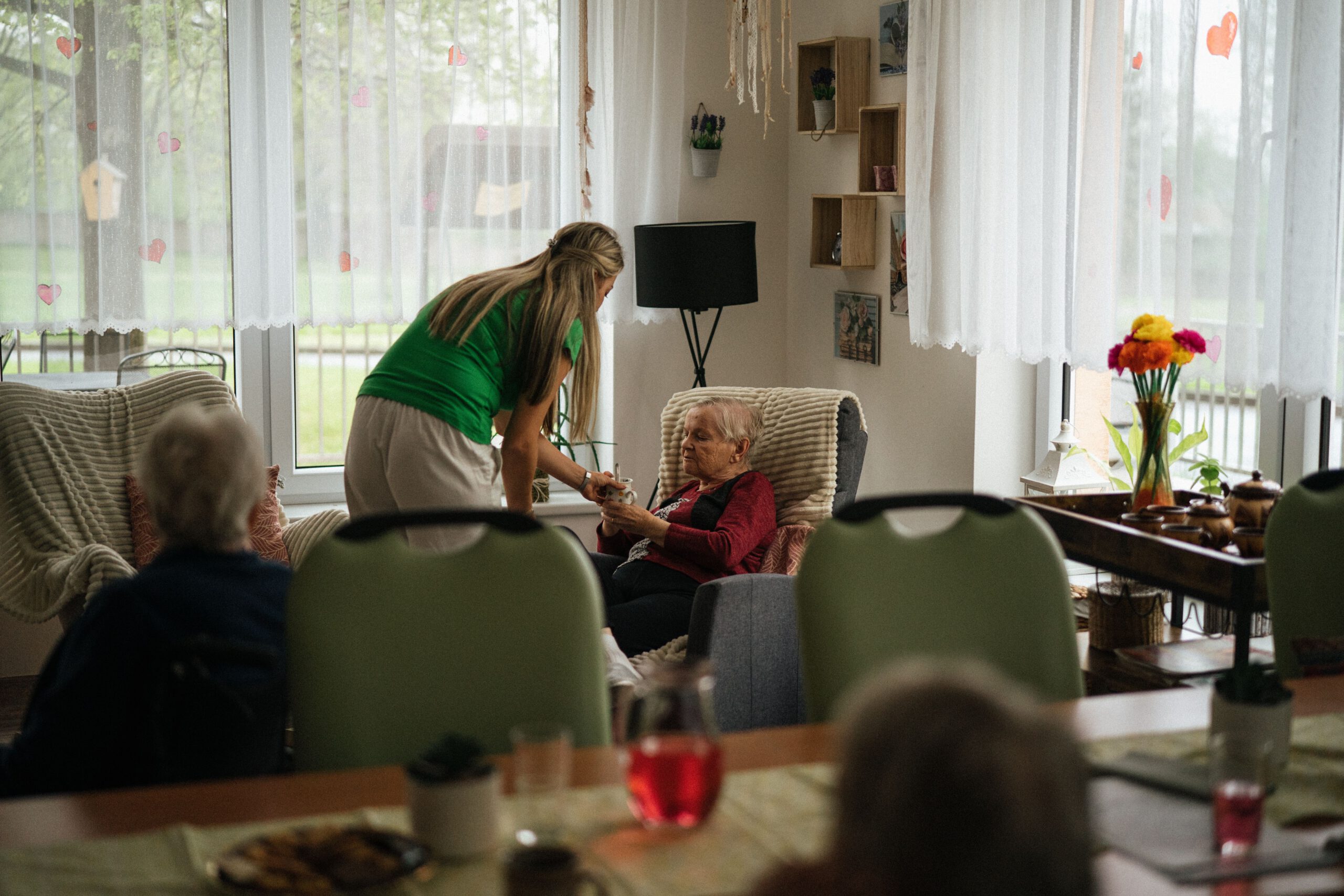
Nobody tells you the real thing when you’re touring a nursing home.
You walk through, you see the clean hallways and the bingo schedule on the wall and the aide who smiles at every resident you pass, and you’re making this impossible decision under pressure, usually because something happened that forced your hand, and you want to believe the place is what it looks like.
Sometimes it is. But the thing that actually determines whether your parent is safe in there has nothing to do with the lobby or the calendar or the tour. It’s how many people are working the floor on a Wednesday night when everyone’s asleep and your parent tries to get up alone.
That’s it. That’s the whole thing.
So Let’s Talk About the Wednesday Night Shift
Federal law sets minimum staffing requirements for nursing homes that take Medicare and Medicaid money. In 2023 the government proposed requiring at least 0.55 hours of RN care and 2.45 hours of nurse aide care per resident per day. That’s the floor. The bare minimum they’re trying to mandate. And a lot of facilities don’t reach it.
Do the math on what that looks like. One aide. Eight, ten, sometimes fifteen residents. All of them needing something. Help getting dressed. Help getting to the bathroom. Turning because they can’t reposition themselves. Feeding. Medication. Call bells going off in multiple rooms at the same time while one person tries to figure out who needs what first.
That’s not a hypothetical. That’s Tuesday. That’s every night in a lot of these buildings.
The overnight shift runs thinner. Weekends run thinner. The hours when administrators aren’t walking around and families aren’t visiting are the hours when care gets stretched until something breaks, and what breaks is usually a person.
Falls
Let me be direct about this.
An elderly woman with osteoporosis hits her call bell. Once, twice. Nobody comes. She’s been waiting twenty minutes and she needs the bathroom and she decides she’ll just do it herself because what else is she going to do, and she stands up and she falls and her hip shatters.
Hip fractures in elderly patients are not like other fractures. The surgery is risky at 82. The anesthesia is risky. The recovery is brutal and long and complicated by every other condition she has. A significant number of elderly patients who fracture a hip die within twelve months, not from the fall but from everything that cascades after it.
Falls are the leading cause of injury-related death in adults over 65. Nursing home residents are at the top of the risk group because so many of them have balance problems, take medications that affect stability, or have dementia that makes them genuinely unable to judge whether standing up alone is safe.
This is not complicated. When there’s enough staff, the person who needs help gets help and doesn’t fall. When there isn’t, she waits too long and makes a terrible decision and ends up in surgery.
Somebody decided how many people to put on that floor. That decision has a consequence and the consequence has a name and she’s in room 14.
Bedsores
Stage 3. Stage 4. Wounds that go through skin, through tissue, into muscle. Sometimes into bone. They are genuinely horrifying to look at on someone you love, they hurt constantly, they get infected, and in an elderly person with a compromised immune system they can kill.
They are also almost completely preventable.
The clinical requirement for a resident who can’t reposition themselves is to be turned every two hours. That’s not a suggestion from a brochure. That’s the established standard of care for keeping skin intact on someone who can’t move themselves. When a facility doesn’t have enough staff to do it, the schedule gets skipped. Not every resident, maybe. But the residents who can’t demand it, who don’t have a family member dropping by every afternoon who might notice the skin breaking down, those are the ones who develop wounds.
A pressure ulcer on a nursing home resident is not bad luck. It’s a record of how long that person was left in one position without anyone checking on them. And in a building running on skeleton crew staffing, that happens all the time to people nobody’s watching.
Medication Errors Don’t Make the News but They Happen Constantly
One nurse. A medication cart. Thirty-plus residents with different medications on different schedules with different food requirements and interaction risks.
She’s supposed to be covering twenty residents tonight because the person who was scheduled called out and the facility decided not to bring someone in. So she’s doing it alone and she’s rushing and she pulls the wrong medication for room 7 or misses the dose entirely for room 12 and the resident in room 12 is on blood thinners and a missed dose matters.
The Institute of Medicine put medication error harm at over 1.5 million Americans annually. Nursing homes are a meaningful slice of that number and understaffing is a meaningful reason why. It doesn’t get reported as a staffing problem. It gets reported as a medication error. The staffing decision that caused it is two steps back from the headline.
Dementia Residents
Honestly this is the part that keeps me up.
They can’t tell you what hurts. They can’t describe symptoms. They wander and they resist care and they communicate distress in ways that require someone paying close attention to notice and interpret correctly.
A sudden change in behavior in a dementia patient, more agitated than usual, refusing to eat, more confused than their baseline, is often the only sign of a urinary tract infection. UTIs in elderly patients frequently don’t present with the typical burning and urgency. They present as a mental status change. Miss it and it becomes a kidney infection. Miss that and it becomes sepsis.
That chain happens. Regularly. In facilities where the staff-to-resident ratio made noticing anything subtle impossible.
If You’re Choosing a Facility Right Now
Go to medicare.gov and find the Care Compare tool. Look up every facility you’re considering. The staffing ratings use payroll data, which is harder to game than self-reported numbers. Find the RN hours per resident per day. Compare it to other facilities in the same area. Below average staffing when you have other options is a real signal.
On the tour, ask specific questions. Not soft ones. What is the aide-to-resident ratio on the night shift. Not in general, specifically on nights. What is your CNA turnover rate. High turnover means a rotating cast of people who don’t know the residents, haven’t built the routines, and are constantly at the beginning of a learning curve.
Come back at weird times. The tour is the facility at its best. Saturday at 6pm is closer to the real thing. Watch how long call lights stay on before someone answers. Watch the residents in the common areas, are they being checked on or just sitting there. Watch whether the staff look like they’re keeping up or drowning.
What you see at 6pm on a weekend is what your parent lives with every day.
If the Harm Already Happened
Move fast. Get the medical records, the incident reports, and the staffing logs for the days around the injury. Facilities are required to keep staffing records. Those logs can show whether the floor was below required ratios on the day something went wrong.
Take pictures. Write down everything you observe and when. Date and time every conversation with staff. Because the facility will have their own account of what happened and it will be written by people whose jobs depend on how it reads.
The FindLaw nursing home abuse overview is worth an hour of your time before you talk to anyone.
Then find a lawyer who actually knows this specific area. Not just personal injury generally. These cases involve federal nursing home regulations, staffing records, and a specific kind of institutional negligence that requires someone who’s handled it before. Jenner Law nursing home injury attorneys handle these cases in Maryland and will give you a straight answer on whether what happened crosses the legal line. Their Super Lawyers profile has the firm background if you want to check them out first.
What Families Can Do Right Now
The families who catch problems are almost always the ones who show up a lot and not always when it’s convenient. Come back on a random Wednesday evening. Come back on a Sunday morning. If the call lights are always on and nobody’s moving toward them, if residents are sitting in wet clothing in the common room, if every staff member looks like they haven’t had a minute to breathe, you’re not seeing isolated incidents.
You’re seeing the staffing problem. Right there in front of you.
Nursing home residents have legal rights. The right to adequate care. The right to be free from neglect. Those rights exist on paper. The family that visits, asks questions, and pays attention is often the only thing making them real.
Author: Leland Bengtson

As a journalist, Leland Bengtson dedicated most of his career to law reporting. His greatest satisfaction is to convey legal matters to the public in a language that they can understand. He is active on various platforms and media outlets, writing about common legal issues that people confront every day. While medical malpractice is his strong suit, Leland covers plenty of other topics, including personal injury cases, family law, and other civil and even criminal legal matters.
Where the legal industry reads first.
Enjoyed this article? Get the biggest legal industry updates, deals, appointments, insights and expert interviews in your inbox, free.
No spam. Unsubscribe anytime.From Legal Desire
Is your firm the one being cited, or the one being skipped?
We ran the test. On several everyday legal questions, software companies are answering and law firms are not. We help firms fix that, and we build the technology behind the practice.
Lawyers and firms: get featured on Legal Desire
Share your deals, lateral moves, firm news and insights with 1M+ monthly readers: founders, law firm partners, general counsel and practising lawyers across the US, UK, EU and GCC.
Get featuredSubmit a press release