
Gait analysis is a way to help solve crimes by looking at how people walk. When we walk, our legs, hips, back and arms all move together in a way that is different for each person. This makes it hard for someone to change the way they walk. Forensic scientists use analysis when they can’t get fingerprints, facial features or DNA from a crime scene or video.
To understand analysis, we need to know how walking works. Walking is made up of phases, such as how we move our hips and bend our knees. Moving our feet and ankles affects how we walk. There are ways to analyze gait: Experts can watch videos. Compare them to known people. They can use cameras and computers to track movement. CCTV footage can also be used.
Gait analysis can help in areas: Finding suspects, reconstructing crime scenes, Investigating CCTV footage, and identifying disaster victims. Gait evidence has some benefits: It is hard to fake, and it can be used with low-quality video.
However there are also limitations: The environment can affect how we walk, Peoples physical conditions can affect their walk. Different experts might interpret evidence differently.
The law has to decide if gait evidence’s good enough to use in court. The future of analysis looks promising with the help of artificial intelligence and deep learning, which can make it more accurate and reliable. Gait pattern analysis and gait analysis are becoming more important in solving crimes. Gait analysis and gait pattern analysis will continue to improve.
Introduction
Gait analysis can be defined as the set of procedures to observe, record, analyze, and interpret movement patterns performed as part of the skill of gait. The aims of gait analysis have been traditionally to gather information in order to understand control, improve performance, diagnose movement disorders, and evaluate treatment and rehabilitation programs.
Gait pattern—the unique, habitual way an individual walks—acts as a vital biometric. In forensics, it is crucial for identifying suspects in surveillance footage or linking footprints left at a crime scene to a specific person when traditional markers like faces or fingerprints are unavailable.
The gait cycle describes the cyclic pattern of movement that occurs while walking. A single cycle of gait starts when the heel of one foot strikes the ground and ends when that same heel touches the ground again. Gait is the action of walking (locomotion). It is a complex, whole-body movement that requires the coordinated action of many joints and muscles of our musculoskeletal system. It mostly includes the movements of the lower limbs, upper limbs, pelvis and spine.
Biomechanics of walking
The gait cycle is the sequence of events that occur from the initial contact of one foot with the ground to the subsequent contact of the same foot with the ground. The stance phase is the period of the gait cycle in which the foot is in contact with the ground. During the stance phase, the lower limb accepts body weight and provides support while the body moves forward. The swing phase is the period in which the foot is off the ground, and the limb is advancing forward.
Factors influencing gait:
- Pelvic rotation – the pelvis rotates in the transverse plane 4 degrees forward on the swing side and 4 degrees backwards on the stance limb (total of 8 degrees); this decreases vertical displacement of the centre of gravity by 9.5mm (3/8in).
- Pelvic tilt – the pelvis tilts or drops down an average of 5 degrees in relation to the horizontal plane on the side opposite to that of the weight-bearing limb during midstance; this decreases the vertical displacement of the centre of gravity by an average of just over 3mm (1/8in).
- Knee flexion after heel strike in the stance phase – at heel strike the knee is fully extended, and at foot flat the knee is flexed 15-20 degrees; this absorbs shock and helps minimise the displacement of the centre of gravity.
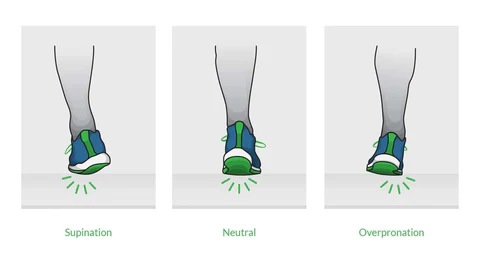
- Foot and ankle motion – at heel strike the foot is dorsiflexed, and the centre of rotation of the ankle is elevated. At the foot flat, the foot plantar flexes and the centre of rotation on the ankle is lowered. At push-off, the heel lifts from the floor and the centre of rotation of the ankle rises again.
- Knee motion – at heel strike, when the center of rotation of the ankle is high, the knee joint begins to flex. During mid-stance, when the ankle centre is low, the knee joint flexes a second time. The effect of this relationship between the motions of the foot, ankle, and knee is to smooth the pathway of the center of gravity.
- Lateral displacement of the pelvis – the centre of gravity must shift over the stance foot to provide balance; otherwise, the person will fall over the unsupported limb.
Methods of Forensic Gait Analysis
Visual comparison: Experts rely on the non-invasive, systematic visual assessment of locomotion. Analysts observe fundamental gait features, such as stride length, step frequency, foot angle, arm swing, and weight distribution, to visually establish matches between a suspect and a perpetrator.
Video and CCTV Analysis: This involves reviewing surveillance footage in pause and reverse modes to study movement patterns. It is crucial for low-quality cases, as analysts apply photogrammetry and morphometric measurement methods to footage to extract spatial and angular features.
Motion Capture Systems: Utilizes camera-based technologies to reconstruct spatial trajectories of joint and limb movements. Traditional marker-based systems capture precise biomechanical data via reflective markers on key anatomical landmarks, while markerless solutions capture underlying skeletal movements through deep learning algorithms.
Applications in Forensic Evidence
- Suspect Identification: Forensic science uses things like DNA and hair to figure out who someone is. It also looks at things like fingerprints and the way people walk.
- Crime Scene Reconstruction: Investigators think about how things happened by looking at the pieces of evidence that were left behind. They use these clues to make a timeline of what happened and to test their ideas about the crime. They even use machines to make 3D models of the scene and to see where the bullets went.
- CCTV Investigations: Experts look at the footage from security cameras to see what happened and when. They try to find out where the people who did the crime went and what they did. They also look for the cars that the people who did the crime used to get there. They have to be careful because sometimes the footage is fake or has been changed.
- Missing Persons and Disaster Victim Identification: When someone is missing or when there is a disaster, forensic teams try to identify the people who were hurt or killed. They do this by looking at the bodies and comparing them to information that the families of the missing people gave them. They use things like teeth and DNA to help identify the people. This helps the police find out what happened to people who were hurt or killed in crimes or disasters.
Advantages and Limitations
Advantages:
- It is really hard to fake how you walk. You can easily hide your face with a mask, sunglasses or makeup. The way you walk is something that you do naturally, and it is very hard to change. Even if someone tries to walk, it is very hard to keep walking like that all the time or when you are stressed.
- You can use quality video to look at how someone walks. You need quality video or to be close to someone to recognize their face or fingerprints. You can use video from a security camera that is far away to look at how someone walks even if you cannot see their face.
- The way people walk is very unique. It is not as unique as DNA. It is still very special. People who look at how someone walks look at things like:
- How long their steps. How wide they are.
- How many steps they take per minute and how long they spend with their feet on the ground.
- How they move their ankles, knees and hips.
- You do not need to catch someone to start looking at how they walk. You can take a video of someone walking. Compare it to video from a crime scene.
Limitations:
- Things like what you wear and where you’re can change how you walk. For example:
- Wearing boots or flip-flops can change how you walk.
- Walking on ground or up a hill can change how you walk.
- Carrying something can change how you walk.
- If someone is hurt or sick, it can change how they walk. For example:
- If someone has a muscle strain or a blister, it can change how they walk.
- If someone is drunk or on drugs, it can change how they walk.
- If someone gains weight, it can change how they walk.
- Looking at how someone walks is not a science. It is not like looking at DNA, where you can say for sure if it is a match. Looking at how someone walks requires a specialist to say if it is a match or not. Sometimes different specialists can have opinions, which can cause problems in court.
- The quality of the video can be a problem. If the video is from an angle or is not clear, it can be hard to look at how someone walks. If the video is not smooth, it can be hard to see how someone is walking.
Legal Admissibility
For court admissibility, it must clear high legal hurdles like the Daubert standard or similar reliability tests globally. Judges assess whether the methodology is peer reviewed, has a known error rate, and enjoys general acceptance.
The primary scientific limitation is the lack of a universal standardized database. Human gait varies daily based on mood, footwear, or minor injuries, making it difficult to establish a strict baseline.
Conclusion
In conclusion, forensic gait analysis has emerged as a vital investigative asset, particularly when traditional biometrics like facial recognition or fingerprints are unavailable. Its primary strength lies in its resistance to disguise and its efficacy at long distances on low-resolution footage. However, its forensic weight remains constrained by environmental variables, physical health fluctuations, and the lack of standardized global reference databases.
Looking forward, the discipline is poised for a significant evolution. As artificial intelligence and deep learning algorithms integrate into video forensics, the extraction of spatial-temporal parameters will become highly automated and less subjective. By minimizing human error and establishing more rigorous statistical error rates, gait analysis will likely transition from a purely corroborative tool into a highly reliable, widely accepted pillar of modern digital forensics.
Where the legal industry reads first.
Enjoyed this article? Get the biggest legal industry updates, deals, appointments, insights and expert interviews in your inbox, free.
No spam. Unsubscribe anytime.From Legal Desire
Is your firm the one being cited, or the one being skipped?
We ran the test. On several everyday legal questions, software companies are answering and law firms are not. We help firms fix that, and we build the technology behind the practice.
Lawyers and firms: get featured on Legal Desire
Share your deals, lateral moves, firm news and insights with 1M+ monthly readers: founders, law firm partners, general counsel and practising lawyers across the US, UK, EU and GCC.
Get featuredSubmit a press release