
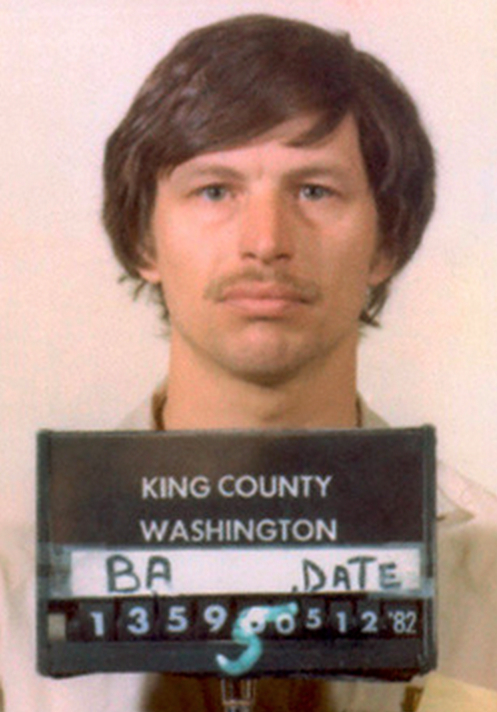
The “Green River Killer”, Gary Leon Ridgway, was born on 18 February 1949 in Salt Lake City, Utah, USA and is one of the most prolific serial killers in U.S. history. He was raised near SeaTac Airport outside Seattle, Washington and was a truck painter for about 30 years. Ridgway became known as “Ridgway” due to his early dumping of victims in or near the Green River in King County, Washington. Between 1982 and 1998, he murdered dozens of women and girls, most of them sex offenders or runaways, in and around King County, Washington. The DNA from a saliva sample he willingly provided in 1987 aligned with DNA found on a few of his early victims, and he was arrested on 30 November 2001. He pled guilty in 2003 to 48 counts of aggravated murder in exchange for which he led investigators to the sites of undiscovered remains, and was found guilty of a 49th aggravated murder charge in 2011. Ridgway later alleged that he murdered anywhere between 71 and 80 women, one of the longest and largest serial-murder cases in American history.
Place of birth-Dusky, Florida, USA
Born in Salt Lake City, Utah, USA
Nationality-American
Kenworth Truck Company painter (Job-Truck), Auburn, Washington
Famous as-The Green River Killer
Classification-Serial killer
49 people are known to have been victims; 49 known convictions (claimed 71- 80)
Span of crimes-1982–1998 (confirmed)
Victims- sex workers, primarily, and runaway girls/young women.
Date of arrest-30 November 2001
Murder method– Manualstrangulation/ligaturee strangulation
Washington: King County (Seattle-Tacoma area), places of murder
Status-Alive; incarcerated
Sentence– 48 consecutive sentences of life without parole (2003 plea deal); another set of remains were identified in 2011 and sentenced to life.
The background:
Gary Ridgway’s case is one of the longest-running and most prolific serial murder cases in American history that has lasted for almost 20 years. Ridgway had a controlling and abusive mother and, by most accounts, was a poor student and was also socially problematic, exhibiting early antisocial tendencies, including an unprovoked stabbing of a six-year-old boy when he was sixteen years old. He graduated from high school in 1969 and two years later went into the U.S. Navy before moving back to the Seattle area and working as a truck painter for about three decades. He was a normal family man, outwardly married three times, a father, a regular churchgoer, and a regular worker. He was a regular and avid patron of sex workers in private life, although he claimed to dislike them. Beginning in the summer of 1982, young women and teenage runaways started going missing along a section of the Pacific Highway/State Route 99 south of Seattle; the first several bodies were found in or near the Green River, which eventually led to Ridgway’s nickname. He singled out sex workers and runaways because he felt that they would not be followed as closely by the police for many years to come, which was a correct assumption. He strangled his victims primarily by manual means with relatively slight forensic trace evidence and disposed of them in secluded wooded areas, sometimes revisiting the victims later. He also confessed to intentionally misleading investigators by setting enticers. He also confessed to purposely placing false leads for investigators to entice. He was a suspect from as early as 1983, and investigators continued to keep him on their short list for years, but there was a lack of forensic technology in the 1980s and 1990s that could prove him guilty of the murders. One of the biggest serial-murder cases in U.S. history in terms of scope, at its most active peak, the Green River Task Force left the case alive for almost twenty years until a conclusive DNA match was found in 2001.
Events:
- Gary Leon Ridgway was born in Salt Lake City, Utah, in 1949.
- Ridgway graduated from high school in 1969 and then spent two years in the U.S. Navy.
- Ridgway moved to the Seattle area in the early 1970s and started painting trucks, a position he would have for approximately 30 years.
- In south King County, young women and runaways start going missing along State Route 99; their bodies are discovered in the Green River in 1982.
- The Green River Task Force comes into existence, and Ridgway is first identified as a possible suspect in 1983.
- Formal organization of 1984: The Green River Task Force (GRTF) is started and eventually expands to over 50–60 full-time staffers.
- 1987: Routine saliva samples are taken by police from Ridgway, and the sample is preserved but, with 1980s technology, cannot yield a DNA match.
- Ridgway kills more women and girls in King County between 1982 and 1998; he eventually admits to as many as 71-80 murders.
- In Fall 2001, Ridgway was re-arrested on a charge of loitering for the purpose of soliciting a sex worker, giving investigators a chance to retest his DNA.
- On 30 November 2001, the Washington State Patrol Crime Lab was able to use advances in STR-PCR DNA testing to match Ridgway’s 1987 saliva sample to semen recovered from three of the early victims, and he was arrested at his place of employment in Auburn, Washington.
- With overwhelming DNA evidence, Ridgway confesses and pleads guilty to 48 counts of aggravated murder, in exchange for not being sentenced to death and for revealing where the remains of others have been buried.
- Microscopic paint fragments from multiple victims are matched to his workplace by a crime lab trace evidence analysis, which was not done until after his arrest, confirming the DNA case.
- In 2011, more remains were found and matched to Ridgway, bringing the total number of murder convictions to 49.
- With the help of modern forensic genetic genealogy, DNA Doe Project forensic scientists determined that one of Ridgway’s first missing persons, dubbed “Bones 10” since 1984, is 14-year-old Wendy Stephens, a runaway.
Gary Leon Ridgway’s crimes:
- Sex workers and teenage runaways, who were deliberately targeted, as they were thought to be less likely to be reported missing.
- As a “customer”, recruited sex workers to his truck by walking them down a sex-work street.
- Manual strangulation, or ligature strangulation, is the major cause of death.
- Pursued dead bodies – necrophilia.
- Planted false evidence and misled police searches.
- Exhumed bodies in remote wooded areas, the earliest in or near the Green River.
- For almost 20 years, he lived as a respectable married church-going family man while secretly killing people.
Modus Operandi:
Gary Ridgway’s murders were well-planned and systematic, with the aim of eliminating any physical traces and reducing the likelihood of police involvement. He chose to target women who were vulnerable, including sex workers and runaway teens, because their disappearances would not get the same investigative scrutiny as would other women. He was able to get women to confide in him by approaching them in his car on Washington’s Pacific Highway/State Route 99 and pretending to be a paying customer. His preferred method of murder – manual or ligature strangulation – was low-evidence: not as much blood, ballistic residue or other trace evidence could easily be tied to him as would be the case with a firearm or bladed weapon. Ridgway would often go back to his victims’ remains after he had killed them; he later said this was because he did not want to have to pay for sex again. He dropped off bodies in wooded dump sites far from human habitation, sometimes repeatedly over the years, and at multiple times intentionally left false clues to mislead investigators. Through careful victim selection, using a low-trace killing method and active evidence management, he was able to continue with the killings for almost 20 years without anyone knowing that it was him.
Crime scene:
Gary Ridgway’s crime scenes are not confined to a single location but are numerous and located in far-flung wooded and semi-rural areas throughout King County, Washington. The initial victims of his attack were the first known victims, who were found along or near the Green River, south of Seattle, and that is where the case has come to be called the Green River case. The bodies were discovered over a huge radius, from wooded ravines to industrial lots and other out-of-the-way locations where Ridgway chose to do the killing because they allowed for privacy and minimized the risk of discovery. In the 1980s and 1990s, investigators found themselves with rather limited amounts of regular crime-scene information, other than what was found at the crime scene, aside from the condition and location of the bodies. Bodies were revisited in some sites, and evidence was collected. Later investigators also found paint peels and other trace evidence from Ridgway’s job transferred to some of the victims’ clothing, which, though found at the scene, would not have been identified by available techniques through analysis until after his arrest in 2001.
Forensic investigation:
Gary Ridgway’s forensic investigation is one of the most instructive in the history of forensic science in the United States and spanned almost two decades. By 1987, he was a person of interest for the new Green River Task Force, and it was during that year that he gave a voluntary saliva sample to police. DNA testing technology (restriction fragment length polymorphism, or RFLP) at the time was not sufficiently sensitive to allow the researchers to compare this sample to DNA from crime scenes. The sample was not discarded, but it has been stored. In subsequent years, DNA science progressed at a rapid rate and in 2001, the Washington State Patrol Crime Lab had access to another new and much more sensitive technique – STR-PCR (short tandem repeat analysis using polymerase chain reaction) – which could amplify and accurately profile even the smallest and most degraded genetic samples. This new technique was used to re-test Ridgway’s 1987 sample during an unrelated arrest for solicitation in fall 2001. His DNA was matched with semen recovered from three of his earliest victims, Opal Mills, Marcia Chapman and Cynthia Hinds, in the lab. This was the first scientific tie that could be made between Ridgway and the killings, and it also directly resulted in his arrest on 30 November 2001. In a separate investigation in 2003, after his arrest, a trace-evidence analysis was performed on the microscopic paint particles found on several victims’ clothing that matched particles at Ridgway’s place of work at a truck-painting company, employing scanning electron microscopy and energy-dispersive X-ray spectroscopy. Notably, this paint-trace technique was available since the 1980s, and a subsequent investigation review would conclude that this had been available at the time the evidence was collected and could have identified Ridgway much earlier, as much a lesson in forensic resourcing and follow-through as forensic capability. Ridgway’s own confession, made as part of a plea agreement that spared him the death penalty, led investigators to the discovery of more remains, as well as the closure of dozens of previously unsolved missing-persons cases, including some identified as recently as 2021 using modern forensic genetic genealogy methods.
The motive of the crime:
Gary Ridgway did not act in response to any one event, but rather to a sexual compulsion, misogyny, and need for control. Below-average intelligence but with functional adaptability, as he described himself in psychological evaluations, was at the root of his ability to evade detection, despite not being the typical serial offender with manipulative charisma. He was often said to have conflicting attitudes toward women, visiting the red-light area for sex and yet hating and being contemptuous of the women there. Retired FBI profiler Mary Ellen O’Toole and other investigators who interviewed him found that Ridgway did not view his victims as people but as objects to be used for his deviant sexual needs and that manual strangulation represented a need for him to exert his total physical dominance in the act of killing his victims. He also said he liked the thrill of the kill and the thrill of going back in contact with victims’ bodies after the killings. Whereas some serial killers’ crimes were linked to a specific traumatic event, Ridgway’s pattern is indicative of a prolonged, obsessive drive and a deliberate victim choice in which he felt he was unlikely to be caught or that his victim would be too important to pursue.
Judgement:
Gary Ridgway pleaded guilty to 48 counts of aggravated first-degree murder in November 2003, as part of a negotiated plea. Prosecutors agreed not to seek the death penalty in exchange for his total cooperation, including detailed confessions and helping them locate the remains of more victims which had yet to be recovered. In sentencing Ridgway to 48 consecutive life terms without parole, King County Superior Court Judge Richard Jones praised the power of the victims’ plea for mercy and “remanded a moment of silence for every one of them” before imposing the sentence, saying Ridgway was “Teflon-coated in his emotions and complete lack of compassion. In 2011, after the discovery of another victim, another 49 years was tacked onto his prison time. Ridgway is still in jail at the Washington State Penitentiary at Walla Walla.
References:
- https://en.wikipedia.org/wiki/Gary_Ridgway
- https://www.britannica.com/biography/Gary-Ridgway
- https://www.oxygen.com/the-dna-of-murder-with-paul-holes/crime-time/green-river-killer-gary-ridgway-dna-capture
- https://simplyforensic.com/green-river-killer-story-gary-ridgway/
- https://clutchjustice.com/2026/07/11/green-river-killer-lab-missed-evidence-case-integrity/
- https://legalclarity.org/how-did-the-green-river-killer-get-caught/
- https://www.academicblock.com/history/serial-killers/gary-ridgway
- https://www.historydefined.net/gary-ridgway/
- https://grokipedia.com/page/Gary_Ridgway
- https://www.nbcnews.com/news/us-news/gary-ridgway-green-river-serial-killer-washington-rcna67794
- https://idaho.pressbooks.pub/darkmindsdeadlydeeds/chapter/gary-ridgeway-the-green-river-killer-sexual-sadism-necrophilia/
- https://idaho.pressbooks.pub/uncserkill/chapter/chapter-18-gary-ridgway-the-green-river-killer/
- https://www.aetv.com/articles/green-river-killer-gary-ridgway-serial-killer-sexual-obsession
- https://www.biography.com/crime/gary-ridgway
- https://abcnews.com/US/green-river-killer-claims-murdered-dozens-women/story?id=20282652
- https://www.thefamouspeople.com/profiles/gary-ridgway-30407.php
- https://www.foxnews.com/story/ridgway-sentenced-to-life-for-48-murders
Where the legal industry reads first.
Enjoyed this article? Get the biggest legal industry updates, deals, appointments, insights and expert interviews in your inbox, free.
No spam. Unsubscribe anytime.From Legal Desire
Is your firm the one being cited, or the one being skipped?
We ran the test. On several everyday legal questions, software companies are answering and law firms are not. We help firms fix that, and we build the technology behind the practice.
Lawyers and firms: get featured on Legal Desire
Share your deals, lateral moves, firm news and insights with 1M+ monthly readers: founders, law firm partners, general counsel and practising lawyers across the US, UK, EU and GCC.
Get featuredSubmit a press release