

Now Reading: Tread Pattern Classification: Distinguish Yaw (Curved Turns), Skid (Braking), and Scrub Marks by Width, Voids, and Direction; Cast With Dental Stone for 3D Preservation.
-
01
Tread Pattern Classification: Distinguish Yaw (Curved Turns), Skid (Braking), and Scrub Marks by Width, Voids, and Direction; Cast With Dental Stone for 3D Preservation.
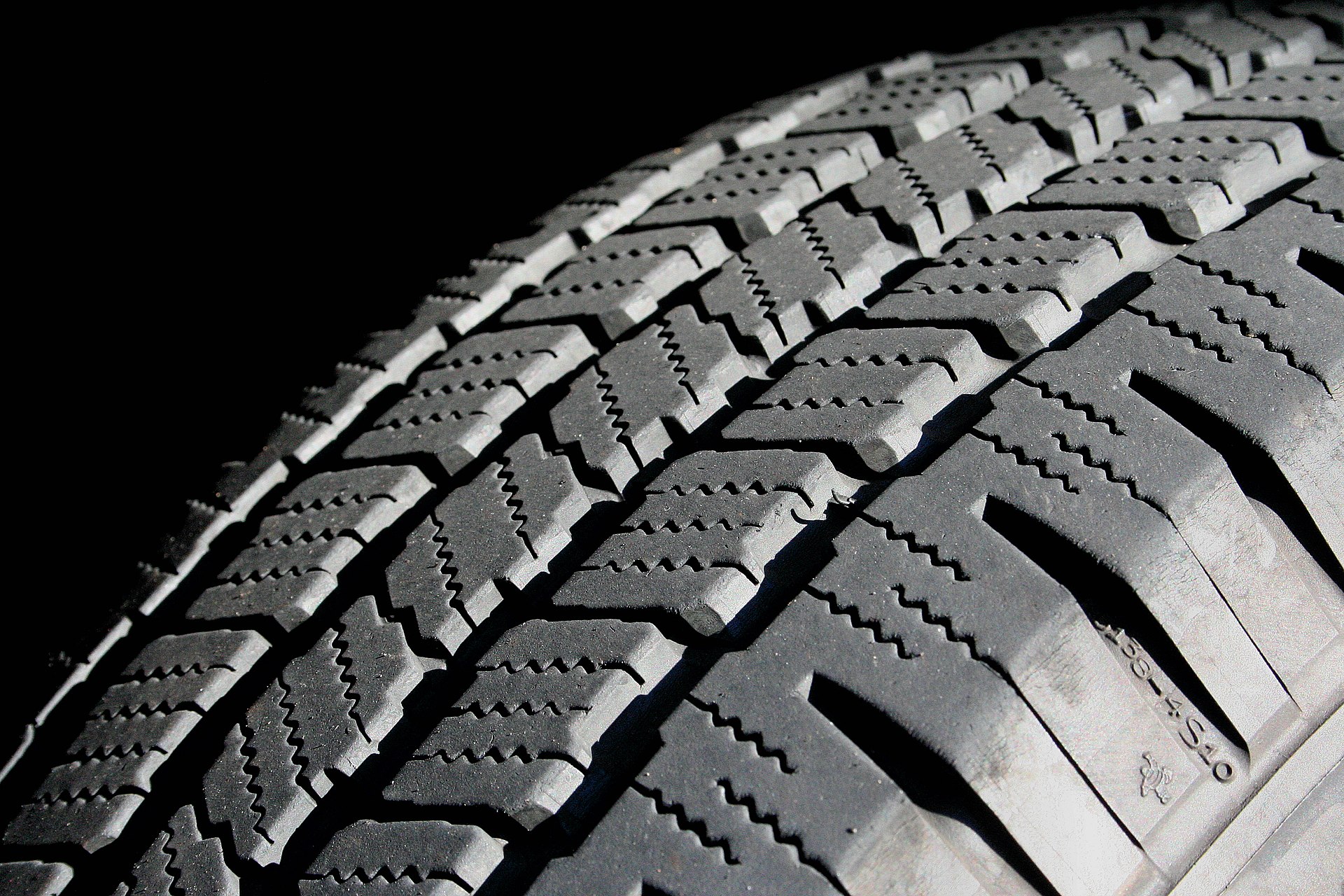
Tread Pattern Classification: Distinguish Yaw (Curved Turns), Skid (Braking), and Scrub Marks by Width, Voids, and Direction; Cast With Dental Stone for 3D Preservation.

Tire‑tread‑pattern classification at a crime scene or accident‑reconstruction site is a specialized facet of impression‑pattern evidence, where investigators distinguish yaw (curved) marks, skid (braking) marks, and scrub (drag) marks by examining their width, void structures, and directional characteristics. [1][2][3] These marks are formed by the interaction of the tire with the substrate—whether soil, gravel, asphalt, or concrete—and retain reproducible morphological features that can be preserved in three‑dimensional casts using dental stone. [4][5] Correctly classifying the mark type informs accident‑reconstruction analysis, impact‑sequence ordering, and, in criminal cases, the direction of travel, speed‑related behavior, and vehicle dynamics just before collision or loss of control. [6][3][7]
Abstract
Tire‑tread‑pattern classification is a critical component of forensic and traffic‑accident investigation, enabling analysts to distinguish yaw (curved) marks, skid (braking) marks, and scrub (drag) marks through evaluation of width, void patterns, and directionality. [1][2][3] Skid marks arise from locked wheels during braking and typically run straight, with uniform width and minimal lateral displacement, providing data on braking distance and possible vehicle speed. [6][3][7] Yaw marks, by contrast, occur when a vehicle travels along a curved or spiraling trajectory at speeds exceeding the adhesion limit, causing the tire to slide laterally while still rotating; these marks exhibit curvature, striations, and often alternate compression and distortion of tread voids, reflecting complex combined longitudinal and sideways forces. [8][3][7] Scrub marks are produced when the wheel is locked or otherwise immobilized, yet the vehicle continues to move, resulting in smeared, often irregular impressions that can indicate the point of impact or post‑impact dragging. [1][2][3]
Distinguishing these mark types relies on careful documentation of each mark’s width profile, the integrity and continuity of tread voids, and the overall direction and curvature relative to the known path of travel. [2][6][7] Once classified, three‑dimensional preservation is achieved through casting with dental stone, which offers high compressive strength, fine detail‑retention, and good dimensional stability compared with traditional plaster‑based materials. [4][9][5] The casting procedure must account for the substrate’s cohesion, moisture content, and feature geometry to minimize distortion and ensure that subtle striations and edge‑detail are faithfully reproduced. [4][9] When integrated with scene‑level measurements and photographic documentation, such casts become enduring physical exhibits that support comparative analysis, juror visualization, and technical validation in both forensic and accident‑reconstruction contexts. [4][3][5]
Fundamentals of tire‑tread impression formation
Tire‑tread impressions arise whenever a loaded tire displaces, compresses, or shears the surface material beneath it, imprinting the inverse of the tread design onto the substrate. [2][5] The precise morphology of the mark depends on factors such as tire pressure, tread‑wear condition, suspension geometry, vehicle speed, and the substrate’s hardness and moisture. [2][3] On relatively soft or unconsolidated surfaces such as soil, gravel, or snow, three‑dimensional “depressions” are commonly formed, whereas on hard‑surfaced roads, the contact may manifest as a two‑dimensional residue trace (e.g., rubber “burn”) or a subtle impression of the pattern. [2][3]
Forensic tire‑tread evidence is treated as pattern‑impression evidence, analogous to shoeprints or tool marks, where the macroscopic design (pattern family) and, where possible, microscopic or individualizing features (wear marks, nicks, repairs) can be used to link a specific tire or vehicle type to a scene. [2][5] The utility of this classification is greatest when the mark is preserved in a material that faithfully records fine‑scale detail, which is why dental stone has become a standard casting medium for three‑dimensional tire tracks and shoeprints alike. [4][9][5]
Skid marks: braking and locked‑wheel dynamics
Skid marks are produced when a wheel locks under braking, so that the tire no longer rolls but instead slides along the road surface while remaining aligned with the vehicle’s longitudinal axis. [1][6][3] Under these conditions, friction between the tire and road generates a continuous transfer‑of‑rubber or a compression‑and‑displacement mark, with the tread pattern typically compressed into a more uniform band along the direction of travel. [6][3] Skid marks are usually straight, or nearly straight, because the steering angle is small and the vehicle’s trajectory is dominated by braking forces rather than lateral slip. [6][7]
Forensic and reconstruction analysts use the length and continuity of skid marks, in conjunction with road‑surface friction coefficients and vehicle‑mass data, to estimate approach speeds and braking‑application timing. [2][3][7] Microscopically, the width of the skid impression corresponds closely to the contact width of the tire, while the voids may appear partially or fully “filled in” due to the sliding motion, which smears the tread edges and reduces the clarity of the pattern. [6][3] Variations in width—such as narrowing or “feathering” at the tail of the mark—can indicate partial braking, intermittent lock‑release cycles, or changes in load distribution as the vehicle decelerates. [2][3]
Yaw marks: curved turns and lateral sliding
Yaw marks arise when a vehicle travels along a curved or spiraling path faster than the tire‑road adhesion can sustain, causing the tires to slide laterally across the surface while still rotating to some degree. [8][3][7] This combination of rotation and lateral slip generates characteristic curved impressions, often with visible striations or “hash marks” oriented at an angle to the long axis of the mark, reflecting the oblique direction of relative motion between the tread and the substrate. [8][3] Yaw marks are always associated with rotational (yaw) motion of the vehicle, such as during a sharp turn, loss‑of‑control maneuver, or post‑impact spin. [3][7]
The curvature of the yaw mark mirrors the radius of the vehicle’s trajectory, so reconstructors can estimate critical‑speed parameters and the onset of instability. [8][3] In terms of tread‑pattern features, the outer edges of the yaw impression may show pronounced shearing or “dragging,” while the inner edges exhibit more traditional rolling‑type voids, because different parts of the tread patch are subjected to varying combinations of longitudinal and lateral forces. [8][3] Width can also vary along the length of the mark, with expansions or contractions corresponding to changing load transfer and slip angles, and the overall mark may show a “stair‑step” or segmented appearance if the driver momentarily modulates steering or braking. [8][7]
Scrub marks: locked‑wheel dragging and impact‑zone indicators
Scrub marks are typically described as impressions left by a wheel that is locked or immobilized while the vehicle continues to move, often as a result of impact‑induced damage, brake lockup, or mechanical failure. [1][2][3] Unlike yaw marks, in which the tire both rotates and slides, scrub marks arise primarily from dragging, producing often smeared, irregular, and sometimes discontinuous impressions that may cross the expected path of travel. [1][2] These marks are particularly valuable for identifying the point of impact or post‑impact movement, as they tend to cluster around regions where the vehicle’s trajectory changes abruptly or where one or more wheels lose normal rolling behavior. [2][3]
Morphologically, scrub marks may show distorted or “washed‑out” tread voids because the continuous sliding action smears the tread edges and merges adjacent grooves. [1][2] The width of the mark can appear wider or narrower than that of a normal rolling print, depending on the angle of the locked wheel relative to the direction of motion and any lateral skidding that occurs. [2][3] In some cases, the scrub trace may bifurcate or fan out, reflecting complex interaction between the locked tire, road surface, and possibly debris or other vehicles, and these features can be critical for reconstructing the sequence of events at a collision scene. [3][7]
Width, voids, and direction as classification criteria
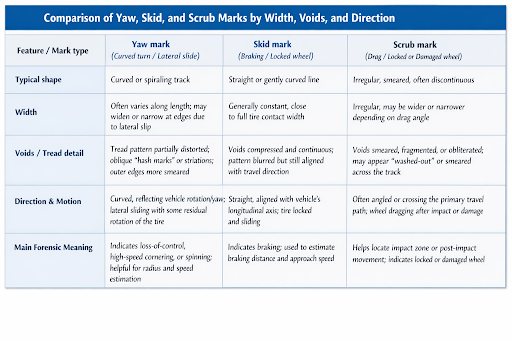
Distinguishing yaw, skid, and scrub marks at the scene relies on a systematic evaluation of three interrelated parameters: width, void structure, and overall direction. [2][6][3] Skid marks are usually characterized by a relatively constant width equal to the tire’s contact width, with voids that are compressed and continuous along the length of the mark but whose lateral continuity is less pronounced due to the sliding motion. [6][3] The long axis of the skid is typically aligned with the vehicle’s direction of travel, and deviations from straightness may indicate partial braking on one side, road‑surface changes, or emerging lateral instability. [6][7]
Yaw marks, in contrast, display curvature and often a changing width profile, with one edge of the mark appearing more sharply defined and the opposite edge showing greater smearing or striations. [8][3] The voids within yaw marks may alternate between more “normal” tread patterns near the center of the contact patch and highly distorted or oblique features toward the outer edges, reflecting the mix of rotational and lateral velocity components. [8][3] Directional analysis of yaw marks is crucial, as their curvature can be used to infer the vehicle’s turning direction, the center of rotation, and the likely point at which control began to be lost. [3][7]
Scrub marks are often identified by their irregular width, broken or fragmented tread patterns, and angular orientation relative to the primary travel path. [1][2] Because the wheel is typically locked or malfunctioning, the voids may be partially or entirely obliterated, and the mark may follow a non‑parallel trajectory to adjacent skid or yaw impressions, indicating a sudden change in wheel alignment or load distribution at the instant of impact or failure. [2][3] Taken together, width, void integrity, and directionality form a diagnostic “triad” that allows forensic practitioners to assign each mark to one of these three broad categories with reasonable confidence. [2][6][3]
Three‑dimensional preservation using dental stone
Once classified and documented, critical three‑dimensional tire tracks are preserved through casting, most commonly with dental stone (also known as die‑stone or improved plaster). [4][9][5] Dental stone is favored over traditional plaster of Paris because it hardens to a higher compressive strength, exhibits lower porosity, and captures fine‑scale detail more faithfully, which is essential for accurate pattern comparison at the microscopic level. [4][9] The casting procedure involves preparing the surrounding area, mixing the dental stone to a controlled water‑to‑powder ratio, and pouring it into the impression in a manner that minimizes air entrapment and distortion. [4][9]
Prior to casting, the impression is photographed, measured, and, if necessary, stabilized with a barrier molding compound or cardboard walls to contain the slurry. [4][5] The dental‑stone mixture is added slowly, often starting at the deepest point of the impression, and allowed to set for several minutes before the cast is carefully removed. [4][9] For deep or irregular tracks, multiple pours or staged casting may be required to ensure that the full relief—especially the sidewall and edge features—is faithfully reproduced without cracking or distortion. [4][9] The resulting cast is then cleaned, labeled, and stored as a permanent physical exhibit that can be compared with known tire samples or with digital templates during later forensic analysis. [4][5]
Integration into forensic and reconstruction workflows
Tread‑pattern classification and dental‑stone casting are not isolated tasks but are embedded within broader scene‑investigation and reconstruction protocols. [2][3][5] Scene photographers first record the overall context, including the positions of yaw, skid, and scrub marks relative to fixed references, vehicles, and impact points, using scale rulers and overlapping photographs to support later three‑dimensional modeling. [2][3] Surveyors and reconstructors then translate these data into quantitative measurements—lengths, radii, angles, and offsets—that are combined with coefficient‑of‑friction estimates to infer speeds, braking forces, and turning characteristics. [3][7]
The preserved casts add a qualitative but essential layer of analysis, allowing examiners to zoom in on tread‑pattern families, wear indicators, and any unique marks that may individualize a tire to a specific make, model, or even a particular vehicle. [2][5] This combination of macroscopic mark‑type classification and microscopic pattern comparison enhances both the evidentiary weight and the interpretive power of tire‑tread evidence, bridging the gap between physical traces at the scene and the dynamic narrative of how a vehicle was operated in the moments before collision or loss of control. [2][3][5]
Comparison table
Conclusion
Tread‑pattern classification of yaw, skid, and scrub marks—based on width, void structure, and direction—provides a reliable framework for reconstructing vehicle behavior at accident or crime scenes. Skid marks reflect controlled braking along a straight or slightly curved path, yaw marks reveal lateral sliding during curved or spinning maneuvers, and scrub marks indicate abnormal or locked‑wheel dragging, often associated with impact or mechanical failure. When these impressions are preserved as three‑dimensional casts using dental stone, investigators obtain durable, high‑fidelity records that support both macroscopic pathway analysis and microscopic pattern comparison.
In forensic and traffic‑reconstruction practice, integrating mark‑type classification with precise measurement, photography, and casting allows for a coherent narrative of speed, direction, and control loss. Dental‑stone casts in particular enhance the probative value of tire‑tread evidence by enabling repeatable, side‑by‑side comparisons with known tires long after the scene has been cleared. Overall, this systematic approach strengthens the scientific rigor of investigations and provides courts and reconstruction experts with tangible, visually intuitive exhibits that link physical traces to dynamic vehicle movements.
Citations
- P. I. N. O. W., “Tire Marks & Their Role in Accident‑Reconstruction Investigations,” PINOW, 2018. [1]
- “Chapter 15: Cast and Impressions,” *Forensic Science: Fundamentals & Investigations*, online text. [2]
- A. Cohen et al., “A new method for casting three‑dimensional shoeprints and tire marks with dental stone,” *J Forensic Sci*, 2011;56(Suppl 1):S210–3. [4]
- StudyGuide.com, “Using Tire Mark Evidence to Reconstruct Accident Scenarios,” online study guide. [6]
- M. Escallón, “Identification of Tire Mark,” Halls acucalc website. [8]
- O. M. I. C. S Online, “Skid Marks and Reconstruction of an Accident,” 2022. [3]
- J.‑S. Lim et al., “Forensic Investigation to Retrieve 3D Shoe Impression,” review article, 2026. [9]
- “Forensic Physics Unit 5: Tyre and Tool Mark Evidence,” Bengaluru North University, 2025. [10]
- StudyGuide.com, “Differentiating Tire Mark Types for Accident Analysis,” online study guide. [7]
- SlideShare, “Tyre impressions and Forensic examination of Tyre Impression,” PowerPoint/notes, 2024. [5]
- Tire Marks & Their Role in Accident-Reconstruction … https://www.pinow.com/articles/2399/tire-marks-their-role-in-accident-reconstruction-investigations
- [PDF] Chapter 15 Cast and – Impressions – evansforensics http://evansforensics.pbworks.com/f/FSci+Ch+15.pdf
- Skid Marks and Reconstruction of an Accident https://www.omicsonline.org/open-access/skid-marks-and-reconstruction-of-an-accident-122602.html
- A new method for casting three-dimensional shoeprints … https://pubmed.ncbi.nlm.nih.gov/21198619/
- Tyre impressions and Forensic examination of … https://www.slideshare.net/slideshow/tyre-impressions-and-forensic-examination-of-tyre-impression-pptx/273891106
- Using Tire Mark Evidence to Reconstruct Accident Scenarios https://www.studyguides.com/study-methods/study-guide/cm2qqiuya119r639y1ixa1qom
- Differentiating Tire Mark Types for Accident Analysis https://studyguides.com/study-methods/study-guide/cm2qqgf4o10ng639yvrd3uh3u
- identification of tire mark https://www.escallonweb.com/Halls_acucalc/tiremarks.htm
- Forensic Review of 3D Shoe Impression Techniques https://www.scribd.com/document/973395147/Forensic-Investigation-to-Retrieve-3D-Shoe-Impression
- Forensic Physics Unit 5: Tyre and Tool Mark Evidence