
Now Reading: Echoes of Crime: How Sound Wave Analysis Solves Criminal Cases
-
01
Echoes of Crime: How Sound Wave Analysis Solves Criminal Cases

Forensic acoustics is an emerging and powerful field within forensic science that utilizes the principles of sound wave physics to analyze and interpret audio evidence in criminal investigations. Sound, often overlooked at crime scenes, can serve as a silent witness, capturing valuable information such as gunshots, footsteps, voices, explosions, and environmental noise. Through advanced techniques like spectrogram analysis, acoustic triangulation, and voice waveform examination, investigators can reconstruct crime scenes, identify suspects, and verify events with high accuracy. This article explores the role of sound wave analysis in solving criminal cases, highlighting the scientific principles behind forensic acoustics and its real-world applications. It explains how sound waves travel, how audio signals are analyzed, and how acoustic evidence is collected and interpreted. The paper also discusses the advantages and limitations of forensic acoustics, along with a brief case study demonstrating its practical use in crime investigation. With the advancement of artificial intelligence, digital signal processing, and high-precision microphones, forensic acoustics is becoming increasingly reliable and widely used in modern criminal justice systems. The future of this field promises improved accuracy, faster analysis, and stronger courtroom evidence. By understanding the echoes left behind at crime scenes, forensic acoustics provides a unique and scientific approach to uncovering the truth and delivering justice.
Introduction
In modern forensic science, evidence is not limited to fingerprints, DNA, or bloodstains. Sound has emerged as an important source of information that can help investigators reconstruct events and identify suspects. Every sound produced during a criminal act—such as gunshots, screams, footsteps, or vehicle movement—creates vibrations that travel through the environment and can be recorded or analyzed later. These sound waves carry crucial information about time, location, distance, and intensity, which can be used to solve criminal cases.
Forensic acoustics is the scientific study of sound and its application in legal and criminal investigations. It involves analyzing audio recordings, detecting sound patterns, and using physics-based methods to interpret sound evidence. With the advancement of digital recording devices, surveillance systems, and mobile phones, audio evidence has become more common in criminal investigations. Investigators now use sound wave analysis to determine the number of gunshots fired, identify speakers in recordings, locate crime scenes, and reconstruct events.
This article explores how sound wave analysis plays a crucial role in solving criminal cases. It discusses the physics of sound waves, forensic acoustic techniques, real-world applications, advantages and limitations, and future developments in this field.
Physics of Sound Waves
Sound is a mechanical wave that travels through a medium such as air, water, or solid materials. It is produced by vibrations and moves in the form of compressions and rarefactions. The main properties of sound waves include frequency, amplitude, wavelength, and speed.
Frequency determines the pitch of the sound and is measured in Hertz (Hz). Amplitude represents the loudness of the sound and is measured in decibels (dB). Wavelength refers to the distance between two consecutive compressions, while speed depends on the medium through which the sound travels.
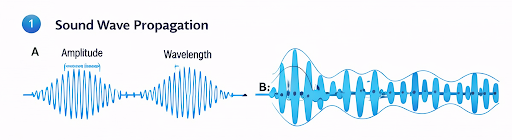
Figure 1: Sound Wave Propagation Diagram
Understanding these properties is essential in forensic acoustics because they help investigators identify different types of sounds and analyze their characteristics. For example, gunshots produce high-frequency and high-amplitude sound waves, while footsteps generate low-frequency patterns. By studying these patterns, forensic experts can distinguish between different sound sources.
Sound waves also reflect, refract, and absorb depending on the surrounding environment. Walls, buildings, and objects can change the direction and intensity of sound, which helps investigators estimate the location of the sound source. This principle is widely used in crime scene reconstruction.
Forensic Acoustics Techniques
Forensic acoustics uses several scientific techniques to analyze sound evidence. These methods combine physics, engineering, and digital signal processing to interpret audio data accurately.
Spectrogram Analysis
A spectrogram is a visual representation of sound that shows frequency, time, and intensity. It helps investigators analyze complex audio recordings and identify specific sound patterns such as gunshots, explosions, or human voices.
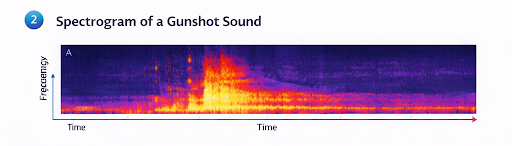
Figure 2: Spectrogram of Gunshot Sound
Spectrograms allow forensic experts to compare different sounds and determine whether they match a known sound pattern. This technique is commonly used in gunshot analysis and voice identification.
Acoustic Triangulation
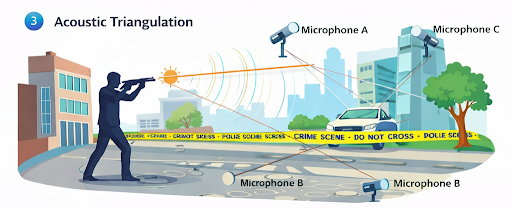
Acoustic triangulation is used to locate the source of a sound by using multiple microphones placed at different locations. By measuring the time difference between sound arrivals at each microphone, investigators can calculate the exact position of the sound source.
Figure 3: Acoustic Triangulation Diagram
This method is widely used in urban crime detection, especially for detecting gunfire and explosions.
Voice Waveform Analysis
Voice analysis involves studying the waveform and frequency patterns of human speech. Each individual has a unique voice pattern, which can be used for identification.
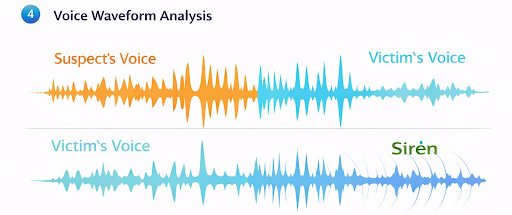
Figure 4: Voice Waveform Analysis
This technique is often used in criminal investigations involving phone calls, threats, or recorded conversations.
Applications in Criminal Cases
Forensic acoustics is used in various types of criminal investigations.
| Application | Description |
| Gunshot Detection | Identifying number and type of shots fired |
| Voice Identification | Matching suspect voices with recordings |
| Explosion Analysis | Determining the type of explosive used |
| Crime Scene Reconstruction | Rebuilding the sequence of events |
| Surveillance Audio Analysis | Enhancing recorded sounds |
These applications help law enforcement agencies gather reliable evidence and solve complex cases.
Crime Scene Sound Reconstruction
Sound wave analysis allows investigators to recreate crime scenes based on recorded audio. By studying background noise, echo patterns, and sound timing, experts can determine the sequence of events and identify suspicious activities.
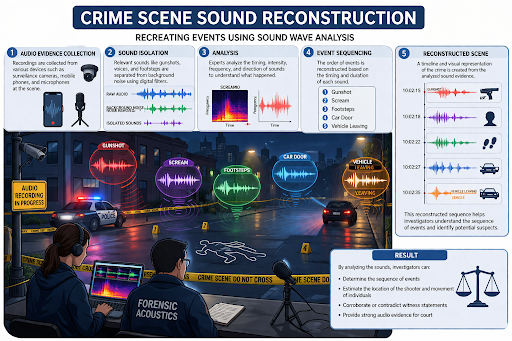
Figure 5: Crime Scene Sound Reconstruction
This method is particularly useful in cases where visual evidence is limited.
Brief Case Study
Gunshot Detection in Urban Areas
In a major urban crime investigation, forensic experts used acoustic sensors placed across the city to detect gunshots. The system recorded multiple gunfire sounds and analyzed them using acoustic triangulation. By calculating the time difference between sound arrivals at different sensors, investigators located the exact position of the shooter.
The spectrogram analysis confirmed that the sound was a gunshot and not a firecracker or vehicle noise. Voice recordings from nearby surveillance cameras also helped identify the suspect. This evidence was presented in court, leading to the successful conviction of the criminal.
This case demonstrates how forensic acoustics can provide accurate and scientific evidence in criminal investigations.
Pros and Cons of Forensic Acoustics
| Pros | Cons |
| Provides scientific evidence | Affected by background noise |
| Helps locate sound sources | Requires advanced equipment |
| Enhances audio recordings | Needs expert interpretation |
| Supports crime reconstruction | Limited by recording quality |
| Useful in court evidence | Environmental interference |
Future Scope
The future of forensic acoustics looks promising due to technological advancements. Artificial intelligence and machine learning are improving sound analysis and making it faster and more accurate. Smart sensors and high-quality microphones are being developed to detect even the smallest sounds.
Researchers are also working on automated gunshot detection systems and real-time voice recognition tools. These innovations will make forensic acoustics more reliable and widely used in criminal investigations.
In the coming years, forensic acoustics may become a standard tool in law enforcement and forensic laboratories.
Conclusion
Forensic acoustics has transformed the way sound is used in criminal investigations. By analyzing sound waves, investigators can uncover hidden clues and reconstruct crime scenes with high accuracy. Techniques such as spectrogram analysis, acoustic triangulation, and voice waveform analysis provide scientific and reliable evidence.
Although there are some limitations, technological advancements are continuously improving the accuracy and reliability of forensic acoustics. The ability to interpret sound as evidence gives investigators a powerful tool to solve criminal cases and deliver justice.
Sound is no longer just noise—it is a silent witness that can reveal the truth behind crimes.
References
- B. C. J. Moore, An Introduction to the Psychology of Hearing, Academic Press, 2013.
- J. Blauert, Spatial Hearing: The Psychophysics of Human Sound Localization, MIT Press, 2015.
- R. Maher, “Acoustic Gunshot Detection and Localization,” Journal of Forensic Sciences, 2017.
- C. Champod, Forensic Science and Crime Investigation, Wiley, 2018.
- National Institute of Justice, “Audio and Video Analysis in Forensic Science,” 2020.
- A. Neustein, Advances in Forensic Speaker Recognition, Springer, 2019.
- D. Bohn and E. Hiebert, Audio Forensics and Acoustic Evidence, CRC Press, 2021.
- Interpol Forensic Science Review Report, 2022.