
Now Reading: Techniques applied in Questioned Document Examination
-
01
Techniques applied in Questioned Document Examination
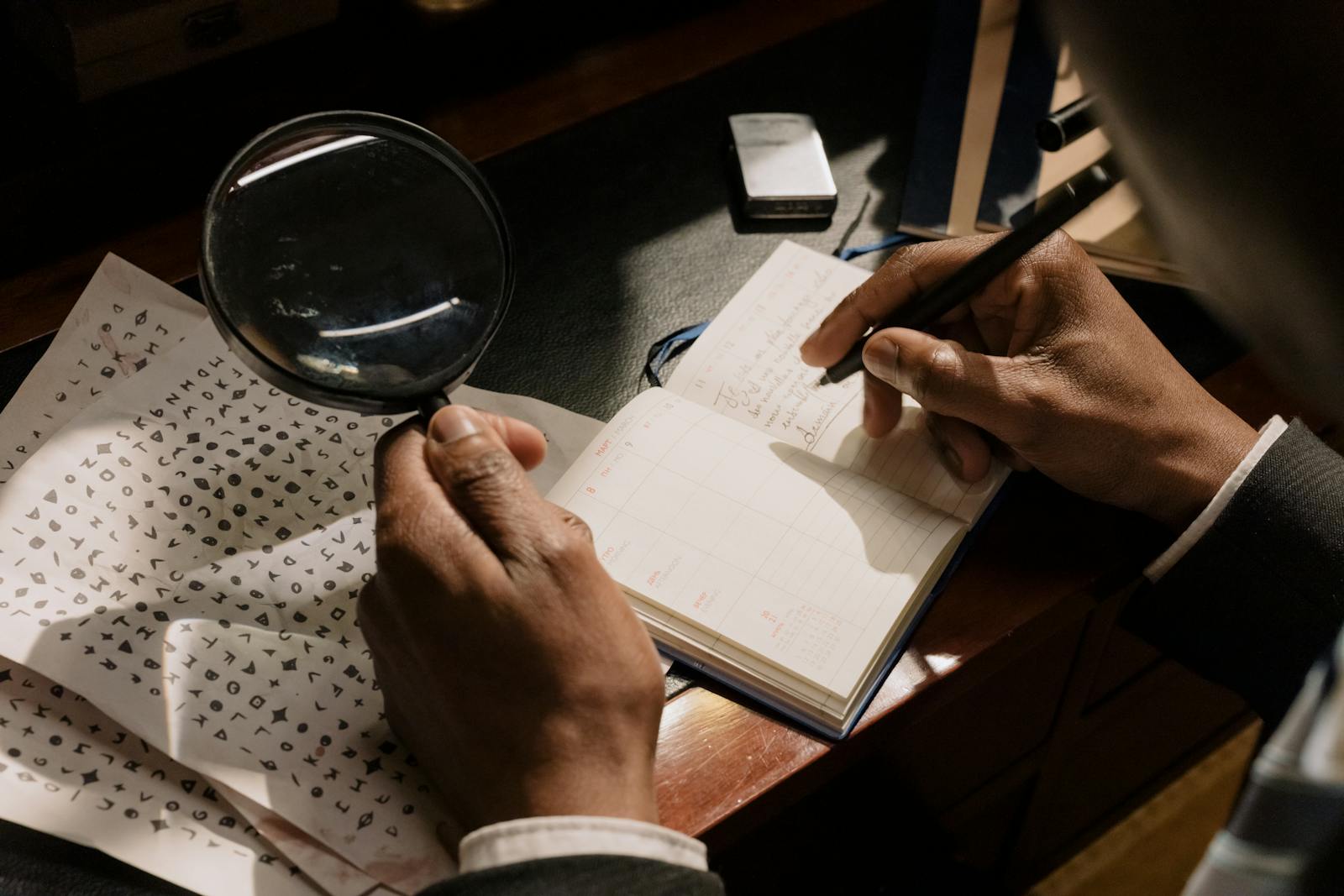

Questioned Document Examination (QDE) is an essential division of forensic science that addresses the issues of authenticity, provenance, and integrity of presented documents in either a legal or investigative context. Cases nowadays also deal with forged signatures, doctored entries, conflicting agreements, forged financial records, doctored certificates, fraudulent identity documents, and documents that are digitally manipulated.
Scientific sources which are open access demonstrate that QDE is based on the combination of optical, physical, chemical, imaging and computational methods, which are gradually developed in non-destructive and technologically advanced directions.
1. Techniques of Visual and Optical Examination.
The visual and optical inspection of a document is always systematic to begin with. This includes consideration of layout, handwriting, ink colour, paper, spacing, quality of lines and any irregularities that may be present. With the naked eye and with the aid of the simplest magnifiers, an examiner will look into hesitations, tremors, non-natural pen lifts, blunt starts or stops, overwriting and irregular slant. Such minor details are almost always signs of forgery or false signatures. Despite being simple, the visual examination preconditions the determination of the further use of more sophisticated techniques.
1.1. Microscopy (Stereo Microscopes, Optical Microscopes, and Comparison Microscopes)
One of the most trusted non-destructive instruments of the forensic document work is microscopic analysis. A stereomicroscope provides a three-dimensional image of pen strokes, ink distribution, fibre texture and indentations. It can be used to define the nature of pen pressure as natural or artificial, the quality of strokes as smooth or shaky and the presence of two overlapping lines created by the same writing tool. Signature comparison requires the use of comparison microscopes in which known and questioned samples can be observed simultaneously. Microscopy also helps greatly in determining the stamp impressions, printed characters, paper fibres, and marks of tampering. The great natural benefit of it is that it is non-destructive, and discloses micro-features which cannot be seen by the naked eye.
1.2 Lateral oblique / Photographic and Lighting Examination.
Oblique or low-angle lighting shows the surface defects in the form of notches, lines, erased, and overwritten writing. When a light beam falls on the document at the side, shadows are formed along depressions; hence invisible writing or erased areas are visible. High-resolution photography permanently records such details and allows their future comparison. This is an easy but effective method since most counterfeiters will scratch or scrape out entries, which will leave traces that are easily revealed when the area is side-lit.
1.3 Infrared (IR) and Ultraviolet (UV) Light.
Variations in inks and papers in response to UV and IR light are based on their chemical compositions. In UV light, certain inks will fluoresce whereas others will be dull, this will be used to detect substituted pages, additions, ink changes, washed entries, or signatures that have been inserted. Infrared imaging particularly proves to be useful since certain inks fade, whereas others are visible when hit with the IR light. This enables latent, erased or lost writing to be visible once again. Both the UV and IR tests are non-destructive, fast and are very helpful in identification of multi-ink forgeries.
2. Tools of Instrumental Examination.
The video spectral comparator (VSC) is utilized in this experiment to measure the spectral response of the camera lens and detect any sensor defects during operation.
2.1 Video Spectral Comparator (VSC)
Video Spectral Comparator is a tool that has the most detailed capability in questioned-document laboratories. It incorporates various light sources (UV, visible, IR), filters, magnification and digital imaging into one device. VSC can distinguish between inks that are not distinguishable during normal light, can detect modifications, can be used to identify a substituted document page, can identify a watermark, can examine security measures and can visualize removed content. Two inks can also be compared through spectral response curves which aid in establishing whether two entries were written by the same pen or not. The advantage of VSC is that it offers non-destructive multi-wavelength imaging that can be seen immediately and display hidden information.
2.2 ESDA Electricity Detection Equipment.
ESDA is the gold-standard method of identifying an indented writing-impression, a set of impressions produced on sheets underneath the sheet on which the writing was actually done. The indentation can also be retrieved by ESDA as a readable electrostatic image even when the top page on which the original writing is written is lost. It is done by putting the document on a porous plate, charging it with the electrostatic charge, and developing the image with the help of toner powder. ESDA is incredibly sensitive and usually retrieves the invisible writing that cannot be seen even during the oblique light. The method is critical when the notebook page is torn, the writing disguised, blackmail-note is found, or there is a possibility of the page replacement.
3. Analytical and Chemical Techniques.
Chemical analysis gives objective data concerning the chemical structure of the inks and the papers as well as printing materials. The techniques are especially essential in uncovering additions that were made at other moments, or in determining whether the inks used in a given questioned lead are of different pens, or that the questioned entries were of the same lot or made by the same manufacturer.
3.1. TLC was used to perform a single-dimensional chromatography on the spotted spots
TLC is an old method of analysis of ink that separates the parts of the ink into visible stripes. Each of the inks, when dissolved in a solvent and placed on a TLC plate, will give a specific pattern of dye migration. Through a comparative study of the migration pattern (Rf values) of suspected and known inks, an examiner may conclude whether the two are the same. TLC particularly comes in handy where it is necessary to determine whether a forged document has been written by more than one pen. TLC is also a very popular technique despite its very minimal destructive nature as it only involves taking a small sample of ink and its ability to be performed with great ease and consistency.
3.2 Raman Spectroscopy
Raman spectroscopy is an analytical instrument that is non-destructive, which determines the molecular compositions of dyes and pigments. When a laser beam is exposed on ink molecules it generates spectral signatures which are specific to that ink formulation. Raman analysis has the ability to distinguish among inks that may seem the same when viewed with the naked eye as well as distinguish added or modified entries and at times, date documents. It is non-destructive thus it is better than the use of chemical methods of extraction. Raman analysis is particularly useful in the study of ballpoint inks, gel inks and printed toners.
3.3 Mass spectroscopy
Mass spectrometry (GC-MS, LC-MS, DART-MS, DESI-MS) is the most commonly used method for the analysis of organic compounds. Mass Spectrometry (GC-MS, LC-MS, DART-MS, DESI-MS) is the most widespread technique of analysing organic compounds.
The mass-spectrometric methods provide very sensitive chemical profiling of inks and toners. Procedures, such as DART-MS (Direct Analysis in Real Time) and DESI-MS (Desorption Electrospray Ionization) enable analysis of the surface almost without destruction. The sophisticated techniques give specific details of ink solvents, dye components and additives and so they are very effective in distinguishing inks or determining a counterfeit stamp. They come in particularly handy in identifying so-called chronological forgeries, in which the perpetrator in question will insert new information into a document later on using a similar-appearing pen.
3.4 Scanning electron microscopy (SEM) and Atomic force microscopy (AFM).
SEM has high-resolution, high magnification images of document surfaces and is used to visualize the structure of paper fibre and toner particles as well as microscopic ink deposition patterns. AFM continues to go then, to a scale of the nanometre surface mapping. They can be used to determine printing technologies (inkjet, laser, photocopy), determine erasures made by hand, and examine forged entries. They are highly potent albeit specialized equipments and skills.
4. Innovation in Imaging and Spectroscopy.
4.1 Hyperspectral Imaging
Hyperspectral imaging images are images of a document at hundreds of small wavelengths. The spectral signature of each type of ink and paper in each band is unique. The method enables distinction between closely related inks, identification of overwritten areas, identification of inserted sheets and authentication of security. Hyperspectral imaging is completely non-destructive and it is being more widely applied in high profile cases because it is sensitive.
4.2 Multivariate Statistical Analysis and Chemometrics.
Hyperspectral imaging produces large data sets, so statistical techniques, like clustering, principal component analysis (PCA), and discriminant functions are applied to data using software-intensive statistical techniques to cluster similar inks or accentuate variations. These mathematical technologies introduce a quantifiable, objective, and reproducible aspect to the analysis of documents, minimizing bias to the examiners and maximizing the accuracy of the interpretation.
- Digital, Computational and Machine-Learning-Based Techniques.
5.1 Automated Signature and Handwriting Verification.
By converting more documents to digital form, researchers have created machine-learning to analyze the scanned signature and handwriting. Deep-learning systems are able to analyze thousands of features – stroke order, pressure change, curvature, slant, rhythm and categorize signatures as authentic or counterfeit. Although such tools cannot substitute professional examiners, they act as supplemental tools giving quantitative assistance in the process of determining authorship.
5.2 Techniques of Digital Image Processing.
Digital forgeries can be improved by means of software-based analysis of faded writing, detecting cut-paste forgeries, and matching scanned signatures with high accuracy. During scanning of photocopies and scanned papers, digital magnification, contrast manipulation, edge detection, and separation of layers are very common during examination. These methods are vital in the contemporary world as most of the forgeries are carried out using digitally altered files, not the actual physical interference.
6. Combined and Intermediary Solutions.
Contemporary forensic laboratories hardly rely on one approach. They instead integrate workflows, e.g., starting with VSC and microscopy, differentiating ink using Raman or TLC, indented writing using ESDA, and digital analysis using the confirmation. Optical, chemical, and digital techniques would be more accurate, less biased by examiners, and comprehensible in court. The hybrid strategies are also useful in case of old, damaged, overwritten, faded, and contaminated documents.
Conclusion
Questioned document examination has become a multidisciplinary specialty, the product of a combination between the more traditional art of studying handwriting and the latest scientific advances. The current range of methods to be used by examiners is starting with the most basic visual examination of an object and going up to advanced spectroscopic and digital analysis to determine forgery, distinguish inks, detect repairs, and even authenticate authorship. The increasing access of non-destructive methods of analysis like VSC, hyperspectral imaging, Raman spectroscopy and machine-learning-based systems enhance the scientific validity and courtroom usefulness of document analysis. With the ongoing developments of forgeries via new printing and digital means, forensically helpful techniques of documents will keep on increasing in their sophistication, so that authenticity can be verified and justice scientifically supported.